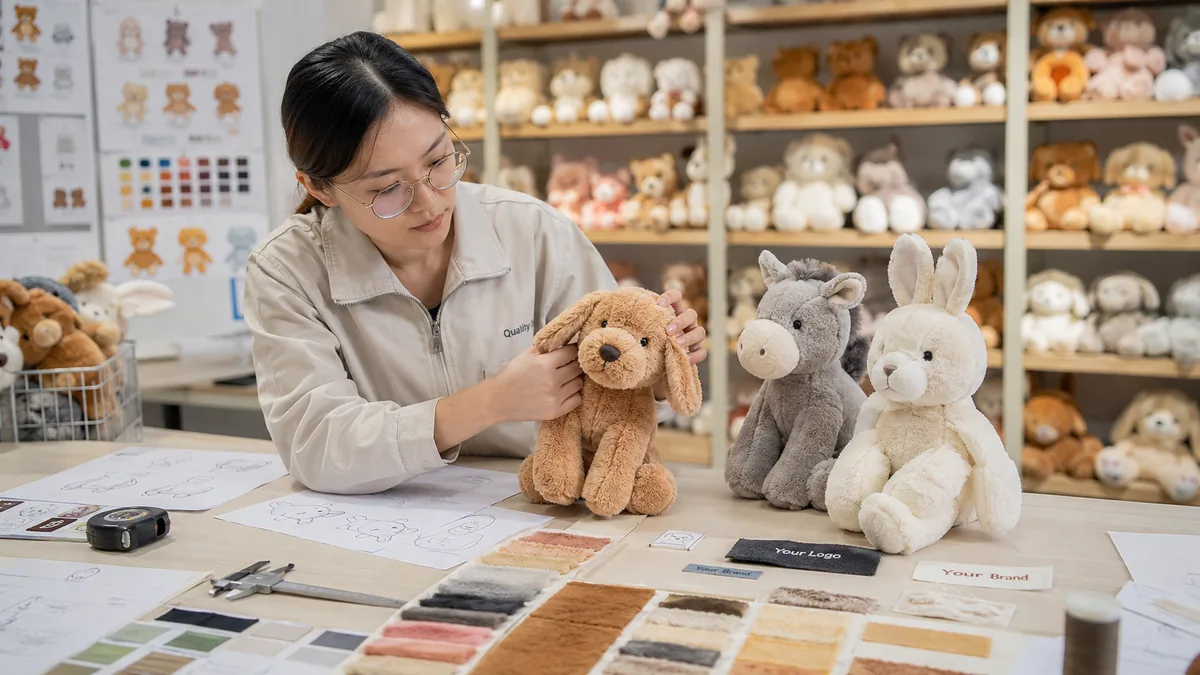
Real factory-process image: decoration decisions are checked together with pattern shape, fabric and construction.
Prepare three consistent views—front, side and back—and identify one production method for each visible detail. Review each finish twice: first on artwork or a material trial, then on the complete physical sample at its intended size. A 10 cm keychain and a 25 cm mascot cannot carry the same detail in exactly the same way.
What is the difference between embroidery, appliqué and printing?
| Method | Best fit | Main sample check |
|---|---|---|
| Embroidery | Eyes, mouths, small logos, outlines and controlled facial details | Thread density, line thickness, pile trapping, stiffness and placement |
| Appliqué | Belly panels, patches, large flat shapes and contrasting fabric areas | Edge quality, fabric direction, seam allowance and behavior on curves |
| Printing | Gradients, repeated patterns, fine graphics and artwork with many color transitions | Sharpness, color, fabric hand feel, distortion and durability route |
| Mixed method | Characters that need tactile features plus graphic detail | How the methods meet, overlap and change the softness of the final plush |
When is embroidery the better choice?
Embroidery can create clear eyes, mouths, names and brand marks without adding separate hard components. It is often effective when the line is large enough to stitch cleanly and the surrounding fabric is stable. The buyer should check whether long pile hides the thread, whether dense stitching makes the area too firm and whether the face remains symmetrical after stuffing.
Do not approve embroidery from a large digital mockup alone. Reduce the artwork to the actual finished size and review a sewn sample on the selected fabric. Very thin gaps, tiny text and closely spaced colors may merge when translated into thread.
When does appliqué work better than dense embroidery?
Appliqué uses a separate cut fabric piece attached to the plush surface. It can preserve softness across a larger area and add material contrast without filling the zone with dense stitches. Common uses include a muzzle, belly, paw pad, crest, patch or clothing detail.
The sample must show the finished edge, not only the flat cut shape. Curvature and stuffing can pull an appliqué panel out of alignment. Narrow corners and tiny internal cutouts may need simplification so the part can be sewn consistently in bulk.
When should a plush buyer consider printing?
Printing may be the practical route for gradients, freckles, complex surface patterns or graphics that would require too many small fabric pieces. The printing method depends on the selected textile and the intended result, so buyers should avoid specifying a process before the factory confirms fabric compatibility.
Check color and sharpness on the actual production material. Also review how the print behaves across seams, curved stuffed surfaces and pile direction. A clean flat swatch can still look distorted when wrapped around a three-dimensional body.
How should facial details be simplified for a small plush?
Start with the features that make the character immediately recognizable: eye shape, mouth position, main color blocks and one or two signature details. Remove micro-text, narrow gaps and decorative lines that disappear at production size. For mini plush keychains, use the size and use-case guide before locking the face.
- Front, side and back artwork at one consistent proportion
- Target finished height and key feature dimensions
- Method callout for every face, logo, patch and pattern zone
- Pantone reference or physical swatch direction
- Target market and age-grade planning
- Approved physical sample kept as the bulk reference
How do buyers approve a mixed-method plush design?
Review the complete face and body as one composition. Embroidery thread, appliqué fabric and printed areas reflect light differently, so matching a screen color is not enough. Use the Pantone and physical swatch workflow, then record the approved fabric, thread, print reference and artwork version.
Finish approval does not replace safety planning. Attached parts, accessories, labels and the finished product must be reviewed for the intended market. The materials and safety guide shows which project inputs to confirm before bulk production.
Frequently Asked Questions
Is embroidery always more premium than printing?
No. Embroidery can add texture and durable detail, but dense stitching may feel stiff or lose very fine artwork. A well-selected print can be the better choice for gradients or complex patterns.
Can embroidery be used on long-pile plush?
It can, but pile may hide small stitches or cross over the edges. The sample should show the result on the selected fabric after trimming and finishing.
Can appliqué replace a large embroidered area?
Often, yes. A separate fabric panel may preserve softness and texture across a large color block, but its edges and behavior on the stuffed curve must be approved.
Can one design combine all three methods?
Yes. Map each zone to a specific process, then approve how the finishes meet on the complete sample at final size.
Continue the design-to-sample route
Need a decoration-method review?
Send the artwork, target size and marked detail zones so embroidery, appliqué and printing can be reviewed together.