TGS factory project fit · Updated August 29, 2026
Toy Gift Supply is a bulk custom plush manufacturer for established brands, retailers, licensed programs and funded merchandise projects. Our standard MOQ is 3,000 pieces per design.
- Required before quotation or sampling: front, side and back views with finished dimensions.
- A single AI-generated image may show the concept, but it is not a production-ready drawing.
- Buyers must own the original character or have authorization to manufacture it.
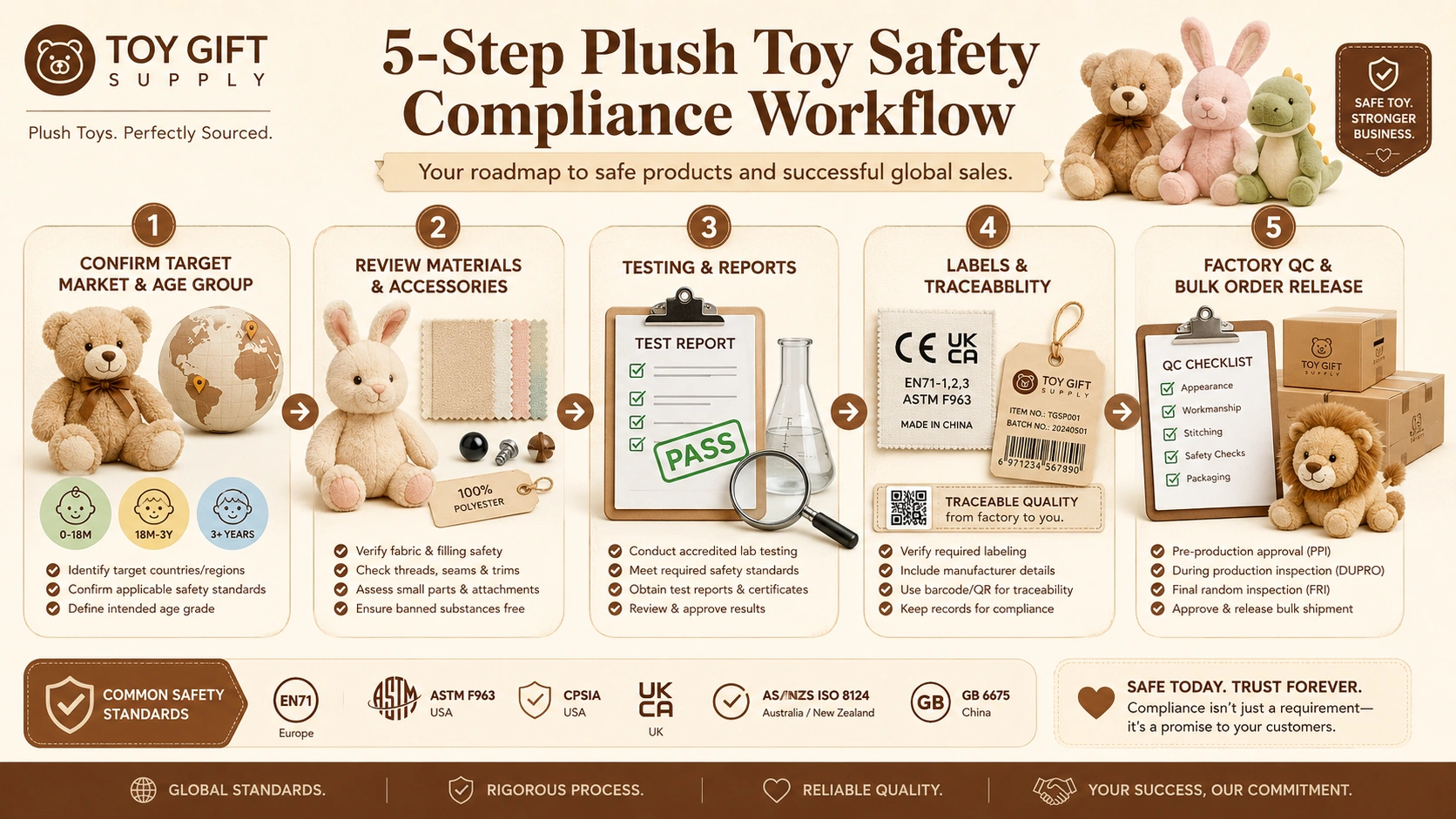
Material selection and safety planning must be based on the complete finished plush product and its target market.
Common Plush Fabrics and Their Uses
| Material direction | Typical appearance and feel | Useful applications | Buyer checks |
|---|---|---|---|
| Short-pile velboa or polyester plush | Clean surface, stable shape and clear color blocks | Mascots, promotional plush, standard retail toys | Pile direction, color consistency and seam appearance |
| Super-soft / minky-style plush | Soft, smooth hand feel with a premium touch | Baby-soft styling, gifts, character plush | Stretch, embroidery support and approved hand feel |
| Long-pile faux fur | Fluffy or fashion-led appearance | Animal characters, collectible plush, bag charms | Shedding, pile trimming, facial visibility and grooming |
| Fleece or boa-style fabric | Warm, textured and casual | Seasonal items, simple characters, soft accessories | Surface pilling, thickness and shape definition |
| Printed polyester fabric | Patterns, gradients or all-over graphics | Licensed artwork, fashion collections, complex markings | Print alignment, colorfastness and seam matching |
| Felt and appliqué | Crisp small shapes and layered details | Eyes, badges, clothing details and decorative elements | Edge finish, attachment strength and age suitability |
Filling and Shape Support
Polyester fiberfill is commonly used for soft plush construction, but the amount and distribution of filling affect hand feel, balance and shape recovery. Some products use internal support, pellets or other components to create a seated base or weighted feel. These additions must be reviewed for the intended age, construction and market.
| Construction choice | Effect | Approval point |
|---|---|---|
| Soft fiberfill | Light, squeezable hand feel | Shape recovery and even filling |
| Firm fiberfill | Stronger silhouette and display stability | Comfort, seam stress and carton compression |
| Pellet or weighted section | Helps the plush sit or creates a collectible feel | Containment, age grade and applicable safety review |
| Internal support | Maintains long necks, ears or posed shapes | Material, sharp-point risk and durability |
Embroidery, Plastic Parts and Accessories
Embroidered eyes and facial details are often selected for soft, child-oriented products because the detail is sewn into the surface. Plastic eyes, noses, magnets, bells, keyrings and electronic modules create different appearance or functionality, but they also add attachment, small-part and testing considerations.
- Confirm whether details are embroidered, appliquéd, printed or attached.
- Review pull strength and seam security for attached components.
- Check metal hardware for finish, edges, corrosion resistance and attachment method.
- Protect hard accessories from scratching the plush or retail packaging.
- Do not assume a component used on one product is suitable for every age grade or market.
Safety Planning Starts with the Target Market
The importer or brand should define the sales country, intended age group and product use before the sample specification is finalized. In the United States, applicable toy requirements can include ASTM F963 and CPSIA-related testing and certification. The U.S. Consumer Product Safety Commission notes that the applicable ASTM F963 sections depend on the specific toy. For the European Union, toys placed on the market must follow the applicable EU toy-safety framework and CE-marking requirements; current transition dates and documentation requirements should be confirmed for the planned launch date.
| Planning area | Questions for the buyer | Factory/sample action |
|---|---|---|
| Intended age | Is the product for young children, general toy use or adult collectors? | Review small components, construction and warnings accordingly |
| Target country | Where will it be imported and sold? | Confirm applicable tests, labels and documents before bulk production |
| Product function | Is it a toy, keychain, cushion, display item or electronic plush? | Review the complete product classification and feature set |
| Accessories | Does it include magnets, batteries, sound, lights, pellets or metal hardware? | Identify additional risk and transport considerations |
| Labeling | What age statement, warnings, importer details and care information are required? | Approve woven label, sewn label, hangtag and packaging artwork |
Sample Checks Before Bulk Production
- Fabric color, pile direction, hand feel and shedding
- Finished dimensions and character proportions
- Embroidery density, thread ends and facial alignment
- Seam strength, stuffing distribution and shape recovery
- Attachment of eyes, noses, clothing, keyrings and other components
- Labels, warnings, care information and country/importer details
- Retail packaging, barcode position and carton protection
- Market-specific testing and document plan
How to Choose a Material Direction
| Buyer goal | Useful starting direction | Watch-outs |
|---|---|---|
| Clear mascot accuracy | Short-pile fabric with embroidery and appliqué | Too much pile can hide small facial details |
| Premium soft hand feel | Super-soft polyester plush | Stretch and embroidery stabilization |
| Fashion or bag-charm look | Long-pile faux fur with metal hardware | Grooming, shedding and attachment strength |
| Detailed printed artwork | Printed polyester panels | Color matching and print alignment across seams |
| Young-child positioning | Soft construction with embroidered details | Age grading and finished-product compliance still require review |
Official compliance references
Buyers and importers should verify current requirements with their test laboratory and responsible market specialist.
How should buyers specify plush toy materials and safety needs?
A plush toy materials and safety guide should connect fabric, filling, embroidery, attached parts, age grading and target market. Buyers comparing custom plush toy materials should approve the exact materials on the physical sample and plan product-specific testing rather than assuming one generic certificate covers every design.
Material review starts after TGS receives complete three-view artwork, dimensions and a 3,000-piece-per-design production plan.
Continue your sourcing plan
Use the approved material route to finalize size, budget, sampling and MOQ.
Frequently Asked Questions
What fabric is commonly used for custom plush toys?
Polyester plush fabrics such as short-pile velboa, super-soft plush and long-pile faux fur are common directions. The best option depends on appearance, hand feel, construction, age grade and target market.
Are embroidered eyes safer than plastic eyes?
Embroidery removes a separate hard attachment, but safety must still be assessed on the complete finished product. The correct choice depends on age grade, design and market requirements.
Can one existing test report cover a new plush design?
Not automatically. The report must be reviewed against the actual design, materials, components, age grade and target market.
What should be confirmed before safety testing?
Confirm the final sample, material and component list, intended age, target country, labels, packaging and any accessories such as magnets, batteries or keyrings.
Does adult collectible positioning remove toy safety requirements?
Classification depends on the product, presentation, intended use and market rules. Buyers should not rely only on a marketing label and should obtain appropriate regulatory advice for the target market.
Need a Material and Safety Review?
Send the artwork, intended age, target country, size, accessories and packaging plan. We will identify the product details that need to be confirmed before sampling and testing.