TGS factory project fit · Updated August 29, 2026
Toy Gift Supply is a bulk custom plush manufacturer for established brands, retailers, licensed programs and funded merchandise projects. Our standard MOQ is 3,000 pieces per design.
- Required before quotation or sampling: front, side and back views with finished dimensions.
- A single AI-generated image may show the concept, but it is not a production-ready drawing.
- Buyers must own the original character or have authorization to manufacture it.
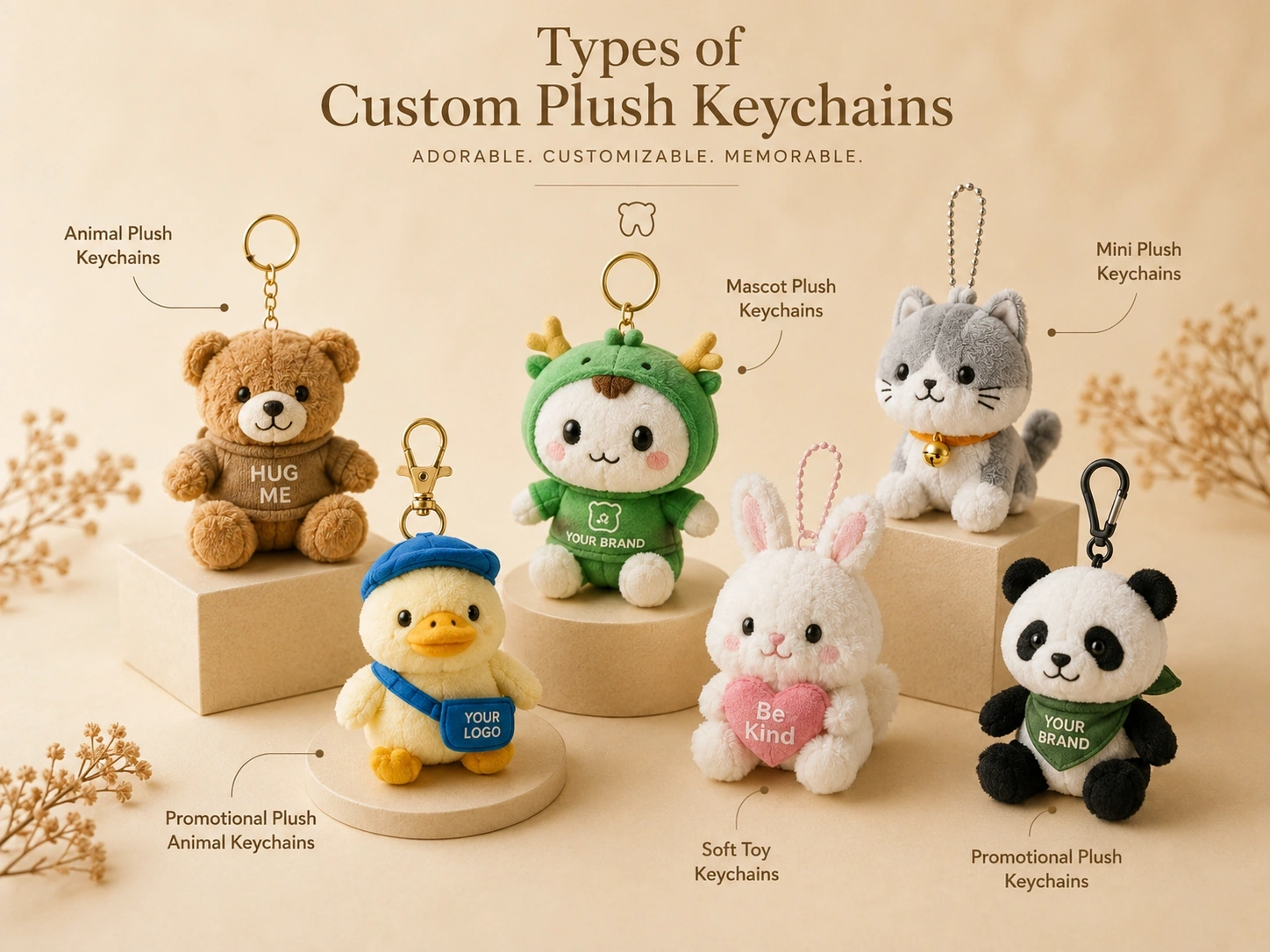
The best mini plush format starts with how the item will be carried, displayed and sold.
Custom Plush Keychain Buying Guide: Size, Detail and Use Case
Choose the carrying and retail use before fixing a plush keychain size. The physical sample should confirm miniature detail, attachment hardware, hanging balance and packaging; the Standard MOQ is 3,000 pieces per design; product specifications and packaging are confirmed during project review.
Choose the use case before the dimensions
A souvenir keychain, fashion bag charm, event giveaway and collectible mini plush can use different proportions and hardware. Tell the factory whether the item hangs from keys, a backpack, a handbag, a retail card or a display box. This determines how much weight, detail and packaging the design can support.
Match size to character detail
| Format | Best use | Design consideration |
|---|---|---|
| Compact mini plush | Counter gift, souvenir or promotional item | Simplify facial features and small accessories |
| Standard bag charm | Backpack or handbag accessory | Balance character visibility with comfortable weight |
| Larger plush charm | Fashion-led collectible or display piece | Review seam strength, attachment point and packaging space |
Exact dimensions should be confirmed through a physical sample. A flat drawing may look clear at full screen size but lose important embroidery and shape details when reduced.
Decide which details must remain
Rank the visual priorities: face, silhouette, logo, clothing, tail, ears or accessory. Embroidery-friendly eyes and mouth details usually reproduce more consistently than very small layered parts. The sample should show which elements need enlargement, simplification or a different construction.
Select hardware for the carrying method
- Ball chain for lightweight souvenir and promotional formats.
- Split ring for familiar keychain use.
- Lobster clasp for removable bag attachment.
- Fabric loop plus metal hardware when the plush needs a reinforced connection.
Hardware finish, ring diameter and connection method should be approved with the plush sample. The attachment point must be practical for the shape and intended use.
Plan packaging around the retail channel
A simple individual bag may be sufficient for bulk promotion, while gift shops may need a hangtag or backing card with barcode space. A display box can improve presentation but may introduce a separate packaging setup requirement and a larger shipping volume.
Send a complete keychain brief
Include front, side and back artwork with finished dimensions, target size, quantity per design, attachment preference, destination market, label and packaging request, and the details that cannot be simplified. TGS does not quote or begin sampling from only one AI-generated image.
When Do You Need a Mini Plush Specialist?
A mini plush keychain manufacturer must control features that are less forgiving than on a larger toy: eye spacing, small embroidery, seam allowance, attachment position and the balance of the finished charm. Buyers searching for a mini plush manufacturer should judge the supplier by the approved mini-scale sample, not by photographs of larger plush products.
Continue your keychain project
Continue to the relevant sourcing page
Review product options, manufacturing support and quotation requirements for this project route.
Open the relevant sourcing page →Ready to choose a mini plush format?
Send the artwork, target size, intended use, hardware preference, quantity and packaging idea for a sample-feasibility review.