TGS factory project fit · Updated August 29, 2026
Toy Gift Supply is a bulk custom plush manufacturer for established brands, retailers, licensed programs and funded merchandise projects. Our standard MOQ is 3,000 pieces per design.
- Required before quotation or sampling: front, side and back views with finished dimensions.
- A single AI-generated image may show the concept, but it is not a production-ready drawing.
- Buyers must own the original character or have authorization to manufacture it.
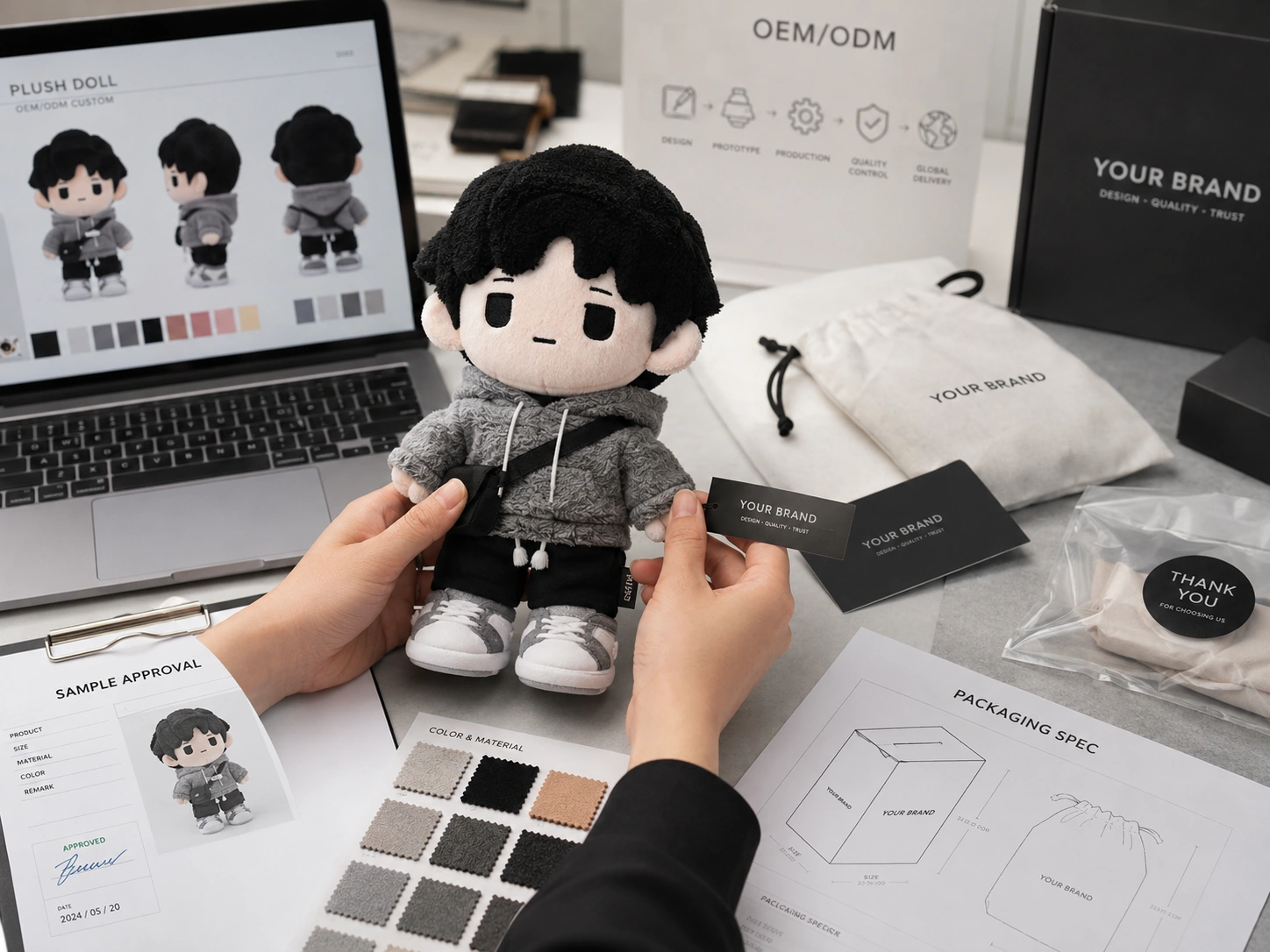
Custom plush pricing should be based on the complete approved specification, not a single headline unit price.
Send your artwork, target size, quantity per design, destination market and packaging request. We can review the project against our 3,000-piece-per-design MOQ and current sample-development baseline before you commit to bulk production.
How much does it cost to make custom plush toys?
There is no single fixed custom plush toy price because the unit cost changes with size, fabric, embroidery, accessories, stuffing, packaging, quantity and testing requirements. Buyers comparing custom plush toy manufacturing cost, custom plush toy cost per unit or custom stuffed animal manufacturing cost should send the same project brief to each supplier so the quotations are comparable.
How much does a custom plush prototype cost?
Custom plush prototype cost and custom plush sample cost are quoted after artwork review. A simple shape, a dressed mascot, a mini keychain and a multi-accessory collectible require different pattern work and sampling time, so TGS does not publish one fixed sample price for every project.
Bulk custom plush cost: what changes by quantity?
For bulk custom plush toys, higher quantities can spread pattern, setup and packaging preparation across more units, but material usage and labor complexity remain important. Standard TGS MOQ is standard MOQ of 3,000 pieces per design; final bulk pricing is confirmed project by project.
What Determines the Price of a Custom Plush Toy?
A custom plush toy is not priced like an off-the-shelf product. Each new design needs pattern development, material selection, embroidery programming, cutting, sewing, stuffing, inspection and packing. A simple rounded character with embroidered details normally has a different cost structure from a long-pile mascot, a mini keychain with custom hardware or a retail gift set with a printed box.
| Cost factor | Lower-cost direction | Higher-cost direction |
|---|---|---|
| Finished size | Compact size with efficient fabric use | Large volume, long limbs or oversized head |
| Shape and construction | Simple body with fewer separate parts | Complex pattern, layered clothing or many small parts |
| Fabric | Standard available short-pile polyester | Long pile, specialty texture, custom print or custom-dyed fabric |
| Face and branding | Limited embroidery positions and colors | Dense embroidery, gradients, appliqué, printing or multiple logo positions |
| Accessories | Standard loop or basic keyring | Custom metal hardware, magnets, sound/light modules or removable outfits |
| Packaging | Bulk packing or simple polybag with required labels | Custom backing card, printed box, display carton or gift-ready set |
How Quantity Changes the Budget
| Quantity per design | Typical use | Budget effect |
|---|---|---|
| Below 3,000 pieces per design | Not accepted for TGS custom production | Use an independent plush artist or a specialist low-MOQ supplier instead |
| Larger production quantity | Reviewed after design and material confirmation | Setup costs are spread across more units, which can improve unit economics |
| Higher-volume orders | Higher-volume distributor, retail program or large campaign | Better production efficiency, while assortment, packaging and delivery planning remain important |
The most useful comparison is not “the cheapest plush price.” It is the landed cost of a product that matches the approved sample, packaging, market requirements and delivery plan. A low initial price can become expensive if important accessories, labels, tests or cartons are added later.
Sample Cost, Mold Cost and Packaging Cost
Custom plush projects normally involve development work before bulk production. Depending on the design, the quotation may separate sample development, special components, packaging samples or testing. Buyers should ask which items are included, which are refundable or deductible, and whether revisions beyond the agreed sample round create additional work.
- Ask whether the quotation is EXW, FOB or another agreed trade term.
- Confirm whether logo labels, hangtags, individual bags and master cartons are included.
- Confirm whether testing, certification support and third-party inspection are included or separate.
- Compare the approved specification, not only the headline unit price.
- Check quantity per design, not only the total purchase quantity.
Budget Direction by Project Type
| Project type | Typical cost position | What usually matters most |
|---|---|---|
| Mini plush keychain | Low to medium | Small-part sewing, embroidery density, hardware and retail card |
| Standard retail plush | Medium | Shape, fabric hand feel, facial detail and packaging |
| Custom mascot plush | Medium to high | Character accuracy, clothing, appliqué and multiple pattern parts |
| Long-pile or fashion plush | Medium to high | Specialty fabric, grooming, color matching and shedding control |
| Electronic or interactive plush | High | Components, battery access, testing, assembly and transport requirements |
Information Needed for an Accurate Quote
- Front, side and back artwork or clear reference images
- Target finished size and measurement method
- Quantity per design and number of designs
- Target market, age grade and sales channel
- Fabric, embroidery, printing and accessory preferences
- Labels, hangtags, retail packaging and carton requirements
- Required sample approval and delivery timing
Cost Questions by Custom Plush Product Type
There is no single custom mascot plush cost because a mascot may include clothing, hats, backpacks, complex embroidery or unusual proportions. The same applies to custom plush keychain price, where mini-scale detail and attachment hardware matter, and to private label plush toy cost, where branded labels and retail packaging may be part of the specification.
Buyers asking how much do custom plush toys cost in bulk should compare quotations at the same size, construction, packaging and quantity per design. The custom plush toy prototype cost is also project-specific and is quoted after artwork review rather than treated as a fixed website price.
Continue your sourcing plan
Use the next guides to define the product before requesting a formal quote.
Frequently Asked Questions
How much does a custom plush toy cost?
The final price depends on the approved design, finished size, fabric, embroidery or printing, accessories, packaging and quantity per design. Send artwork and project details for a project-specific quotation.
Does a larger order always have a lower unit price?
A larger quantity can improve production efficiency, but the result also depends on materials, packaging, number of designs and delivery requirements.
Is sample development included in the bulk unit price?
No. Sample development is quoted separately after we review the artwork, size, materials, construction and accessories. Typical sample development takes approximately 15–20 days. Sample shipping is confirmed separately based on destination and shipping method. Bulk unit pricing is quoted separately from the approved design, materials and packaging.
Why is a mini plush keychain not always the cheapest option?
Very small products can require precise sewing, dense embroidery and custom hardware. Small size reduces material use but does not remove development and assembly work.
What is the TGS MOQ?
Toy Gift Supply’s standard MOQ is 3,000 pieces per design. Design, materials, accessories, packaging and market requirements are confirmed during project review.
Need a Project-Specific Plush Quote?
Send your artwork, size, quantity per design, market and packaging request. We will review the real production setup instead of guessing from a reference photo.