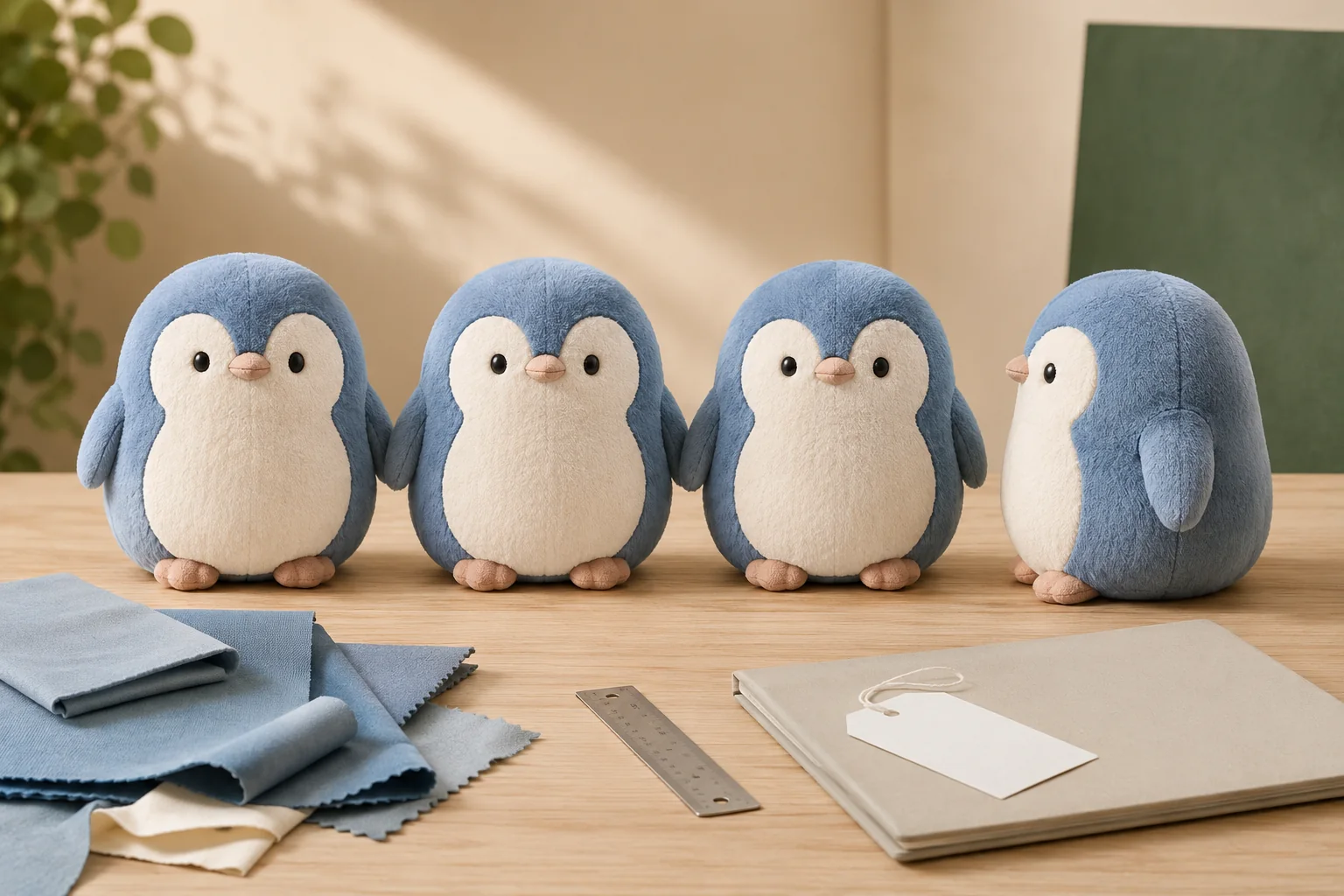
Toy Gift Supply's Dongguan factory brings over 10 years of custom plush manufacturing experience and long-term international-brand OEM experience to bulk projects. Our factory tour includes sample development, embroidery, sewing, stuffing, finishing and packing. Quality criteria and inspection arrangements are confirmed for each order; this guide does not promise a universal defect rate or zero variation.
What makes a plush character consistent?
Consistency is more specific than saying a toy looks “high quality.” For a character brand, a slight shift in eye placement or muzzle shape can change the expression even if the seams are tidy. For a retailer, differences in size, stuffing or hangtag position can affect how the collection appears on a shelf.
Start by identifying the features that carry the design: silhouette, head-to-body proportion, face placement, ear position, color blocks and distinctive accessories. Rank them before production. A long list of equally important comments is difficult to use; a clear set of critical features helps the buyer and factory discuss the same product priorities.
How should buyers define the approved reference?
Keep the physical sample and written specification together. Photograph the sample from consistent angles, record the approved version and show how each key dimension is measured. A height measured including ears cannot be compared meaningfully with one measured to the top of the head. Agree the method before setting acceptable variation.
Use material references for fabric, pile, thread and filling where they affect the result. Do not assume a photograph defines softness or shade accurately. Our color-matching guide explains why physical references matter, while the sample approval checklist covers the broader sign-off process.
Which checks help protect character identity?
| Feature | Useful reference | Question for the production review |
|---|---|---|
| Silhouette and proportion | Approved sample and defined measurement points | Are the head, body and limbs balanced against the reference? |
| Face expression | Close-up artwork and sample photographs | Are eyes, mouth and muzzle in the agreed relationship? |
| Fabric and color | Accepted swatch, pile direction and material reference | Does the bulk material match the agreed appearance and feel? |
| Stuffing and finish | Physical hand-feel reference and shape notes | Is filling distribution changing posture or expression? |
| Accessories and labels | Approved placement and attachment details | Are the correct components attached as specified? |
| Pack-out identity | SKU list and approved packing instructions | Does each product match its label, package and carton allocation? |
Why check during production rather than only at the end?
A final inspection can reveal a problem, but it does not explain why that problem has repeated. An early review can connect an issue to the affected material, pattern interpretation, embroidery placement or stuffing approach. Agree appropriate review points and the information the buyer needs to see before assuming the entire run will match a sample photograph.
If a discrepancy appears, identify the affected work and compare it with the approved reference. Record the correction and decide whether another check is needed. For example, in a hypothetical mascot run, uneven stuffing may tilt the face even when embroidery placement is correct. The useful response is to review the cause and the corrected result, not simply to request a more flattering photo.
How does TGS's factory background support this discussion?
Our manufacturing scope connects sample development with embroidery, sewing, stuffing, finishing and packing. This matters because character consistency depends on several stages, not one final visual check. Review the actual factory process photographs and discuss how the proposed controls will apply to your design.
TGS holds a FAMA certificate and has long-term OEM manufacturing experience for international brands including Disney, Universal and Pokémon. These credentials introduce our background; they are not a substitute for agreed quality criteria on your order. See the factory documentation guide if your procurement team needs to review the relevant evidence.
What changes when the order serves several markets?
The plush design may remain the same while labels, language, packaging or receiving requirements differ. Keep each market's approved pack-out linked to the correct SKU. Ask for a clear record of which product goes into which retail package and shipping carton, especially when several versions are packed during the same project.
Visual consistency also remains separate from product safety. Your compliance team should define the applicable requirements for the product, age group and destination. Avoid treating a neat finish, an OEM history or a factory document as proof of every market requirement. Our compliance planning checklist provides a separate starting point for those questions.
How can buyers prepare a more useful quality brief?
Send production-ready views, dimensions, material preferences and a short list of non-negotiable character details. Identify what can be simplified without changing the brand identity. Then use the pre-production meeting checklist to agree references and responsibilities before release. TGS's minimum is 3,000 pieces per design; we welcome a process discussion before your full brief is ready.
Frequently Asked Questions
Can every plush in a bulk order be perfectly identical?
Textile products have natural variation. Define the critical features, measurement methods and acceptable variation with the manufacturer instead of expecting an undefined promise of perfect identity.
Does a good sample guarantee the bulk run will match?
A sample is the reference, not a complete control plan. Bulk materials, production instructions, review points and packing checks must also be agreed for the order.
Should we set one tolerance for every measurement?
No. Different features may need different measurement methods and acceptance criteria. Agree the relevant limits for the design rather than applying an arbitrary universal tolerance.
Is visual quality inspection the same as product safety testing?
No. Appearance and workmanship checks serve a different purpose from product-safety testing. Confirm both the quality plan and the applicable market requirements for the finished product.
Prepare your next procurement step
Have a character that needs careful bulk execution?
Show us the design details that matter most, your quantity per design and destination market. We can discuss the production brief together.