TGS factory project fit · Updated August 29, 2026
Toy Gift Supply is a bulk custom plush manufacturer for established brands, retailers, licensed programs and funded merchandise projects. Our standard MOQ is 3,000 pieces per design.
- Required before quotation or sampling: front, side and back views with finished dimensions.
- A single AI-generated image may show the concept, but it is not a production-ready drawing.
- Buyers must own the original character or have authorization to manufacture it.
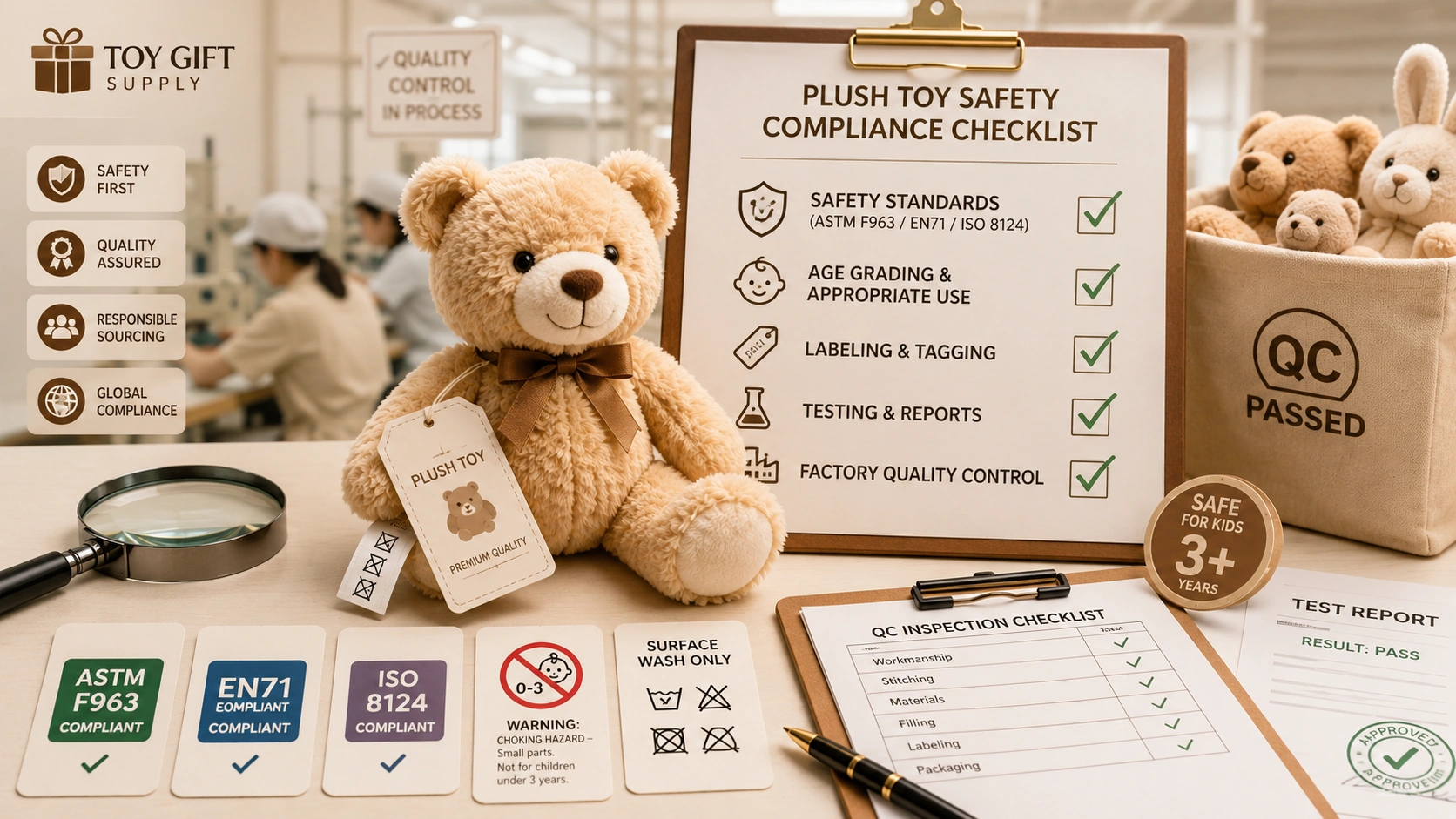
A test report must match the actual product, materials, age grading and destination-market requirements.
What does “ASTM certified plush toy manufacturer” mean?
Buyers often search for an ASTM certified plush toy manufacturer, ASTM F963 plush toy manufacturer, CPSIA compliant plush toys manufacturer or EN71 certified plush toy manufacturer. A safer buying approach is to confirm the finished product, target age, applicable sections, required laboratory testing and documentation for the destination market instead of assuming one blanket factory certificate covers every design.
For US children's toys, ASTM F963 requirements and CPSIA obligations depend on the product and applicable rules. For EU toys, CE marking is the manufacturer's declaration that the toy satisfies applicable safety requirements; EN 71 harmonised standards are commonly used in conformity assessment. Market requirements should be reviewed for the finished product before shipment.
Plan compliance around the exact finished product
Start with the destination market, product classification and intended age group. Control one product specification, confirm the applicable test and labeling plan with qualified parties, and keep bulk materials, construction and packaging consistent with the approved sample.
Start with Product Classification and Target Market
Before a supplier proposes testing, the buyer should confirm where the product will be sold, the intended age group and whether the item is marketed as a children’s toy, collectible, decoration or another product type. Changing the classification after sampling can affect materials, accessories, warnings and documentation.
U.S. Plush Toy Compliance Checklist
For children’s toys in the United States, ASTM F963 is a mandatory toy safety standard through federal regulation. The CPSC identifies ASTM F963-23 as the mandatory version for toys manufactured after April 20, 2024. Products intended primarily for children 12 and under generally require testing by a CPSC-accepted third-party laboratory and a Children’s Product Certificate covering applicable rules.
- Confirm whether the product is a children’s product and identify the age grading.
- Identify the ASTM F963 sections and other CPSC rules applicable to the specific design.
- Review accessible materials, surface coatings, small parts, seams and attachment strength.
- Check regulated substances and accessory risks, including plastic or metal components where applicable.
- Plan permanent tracking information on the product and packaging.
- Ensure the importer can prepare and maintain the required CPC and supporting test records.
- U.S. importers should review current CPSC certificate eFiling requirements for regulated imports.
EU Plush Toy Compliance Checklist
Toys placed on the EU market must meet EU toy safety requirements and carry CE marking. The manufacturer must perform a safety assessment, prepare technical documentation, complete the appropriate conformity assessment, issue a Declaration of Conformity and provide traceability, instructions and warnings where required.
2026 transition note: the new EU Toy Safety Regulation entered into force on January 1, 2026, while its main requirements apply from August 1, 2030. Buyers should manage current obligations and monitor transition requirements for future product programs.
- Confirm applicable harmonised standards, commonly including relevant EN 71 parts.
- Review mechanical, physical, chemical, flammability and hygiene risks for the actual product.
- Prepare product identification, manufacturer and importer information, and batch traceability.
- Confirm CE marking, warnings, instructions and language requirements for the destination market.
- Maintain technical documentation and the Declaration of Conformity.
Product Details That Change the Test Plan
| Product feature | Potential compliance concern | Action before sampling |
|---|---|---|
| Plastic eyes or noses | Small parts, attachment and material requirements | Confirm age grading and whether embroidered details are safer. |
| Key rings and metal clips | Sharp points, coating, attachment and intended use | Specify hardware and market at quotation stage. |
| Sound or light modules | Electrical, battery, sound-level and access risks | Review the complete module and battery compartment. |
| Magnets | Magnet size, flux and secure containment | Use a product-specific risk assessment. |
| Long pile fabric or fillings | Material quality, cleanliness and flammability considerations | Approve material specifications before testing. |
| Printed packaging and labels | Warnings, traceability and importer information | Do not finalize packaging before compliance copy is reviewed. |
Do Not Accept a Generic “Certificate” Without Checking It
- Does the report identify the same product or a justified product family?
- Do the materials, colors, accessories and age grading match?
- Is the destination market and applicable standard clear?
- Is the laboratory appropriate and, where required, officially accepted?
- Are the report date, applicant, manufacturer and model details consistent?
- Can the document be linked to the goods, labels and production batch?
A factory audit, management-system certificate or old test report does not automatically prove that a new plush design complies. Finished-product review and buyer-side certification responsibilities still need to be addressed.
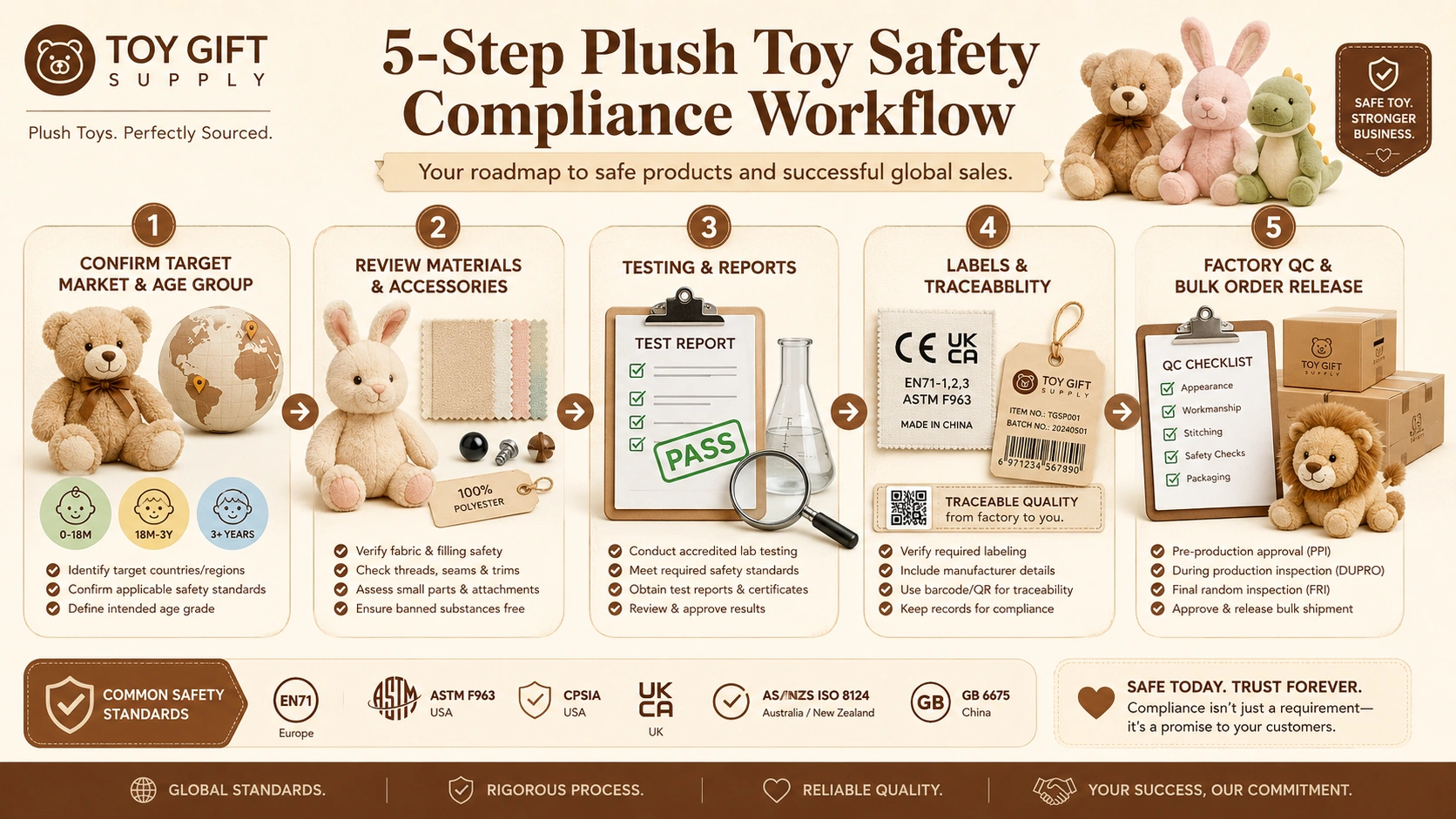
Bulk Quality Control Still Matters After Testing
Testing is based on submitted samples. Bulk goods should remain consistent with the approved materials and construction. Production checks should cover seams, stuffing, embroidery, accessory attachment, cleanliness, labels, packaging and carton identification.
Assign responsibilities and control one specification
| Party | Typical responsibility | Record to keep |
|---|---|---|
| Brand, importer or retailer | Confirm destination market, age grade, claims, labels and commercial requirements | Market checklist and approved packaging copy |
| Manufacturer | Build the approved product and control materials and workmanship | Approved sample, measurement sheet, material references and QC records |
| Qualified laboratory or compliance adviser | Confirm the applicable test scope and evaluate the submitted product | Product identification, tested sample and issued report |
The controlled specification should identify the finished size, fabrics, filling, embroidery, attached parts, seams, labels, packaging and intended age group. When a component changes after testing, the responsible parties should review whether the change affects the approved specification or test scope.
What Does a Safe Custom Plush Toy Manufacturer Need to Control?
A safe custom plush toy manufacturer should treat safety as a finished-product process: material selection, attached parts, embroidery, seam strength, filling, age grading, labels, sample approval, testing and bulk-production consistency all matter. Buyers should verify the requirements for the destination market and the specific design instead of relying on one broad certification claim.
Continue your compliance planning
Connect the market checklist with sample approval and production control.
FAQ: Plush Toy Safety Compliance
Is EN 71 or ASTM F963 enough for every plush toy market?
No. Requirements depend on the destination country, product classification, age grading, materials and features. Buyers must identify all applicable rules.
Which ASTM F963 version applies in the United States?
The CPSC identifies ASTM F963-23 as mandatory for children’s toys manufactured after April 20, 2024, subject to the applicable federal rules and product-specific sections.
Does a factory certificate prove that a product is compliant?
No. Factory audits and management-system certificates do not replace product-specific testing, certification, labels and importer responsibilities.
Can one old test report cover a new plush design?
Only when a qualified review supports the product-family relationship and the materials, construction and applicable requirements are properly covered. Do not assume automatic coverage.
When should compliance be discussed?
Before sampling, so the materials, accessories, labels and packaging can be developed for the target market from the beginning.
Continue to the relevant sourcing page
Review factory capabilities, MOQ, sampling, packaging and quotation requirements for this project route.
Custom Plush Toy Manufacturer in China →Preparing a Plush Project for a Regulated Market?
Send the destination country, age group, design, materials, quantity and requested documentation so the project can be reviewed before sampling.