TGS factory project fit · Updated August 29, 2026
Toy Gift Supply is a bulk custom plush manufacturer for established brands, retailers, licensed programs and funded merchandise projects. Our standard MOQ is 3,000 pieces per design.
- Required before quotation or sampling: front, side and back views with finished dimensions.
- A single AI-generated image may show the concept, but it is not a production-ready drawing.
- Buyers must own the original character or have authorization to manufacture it.
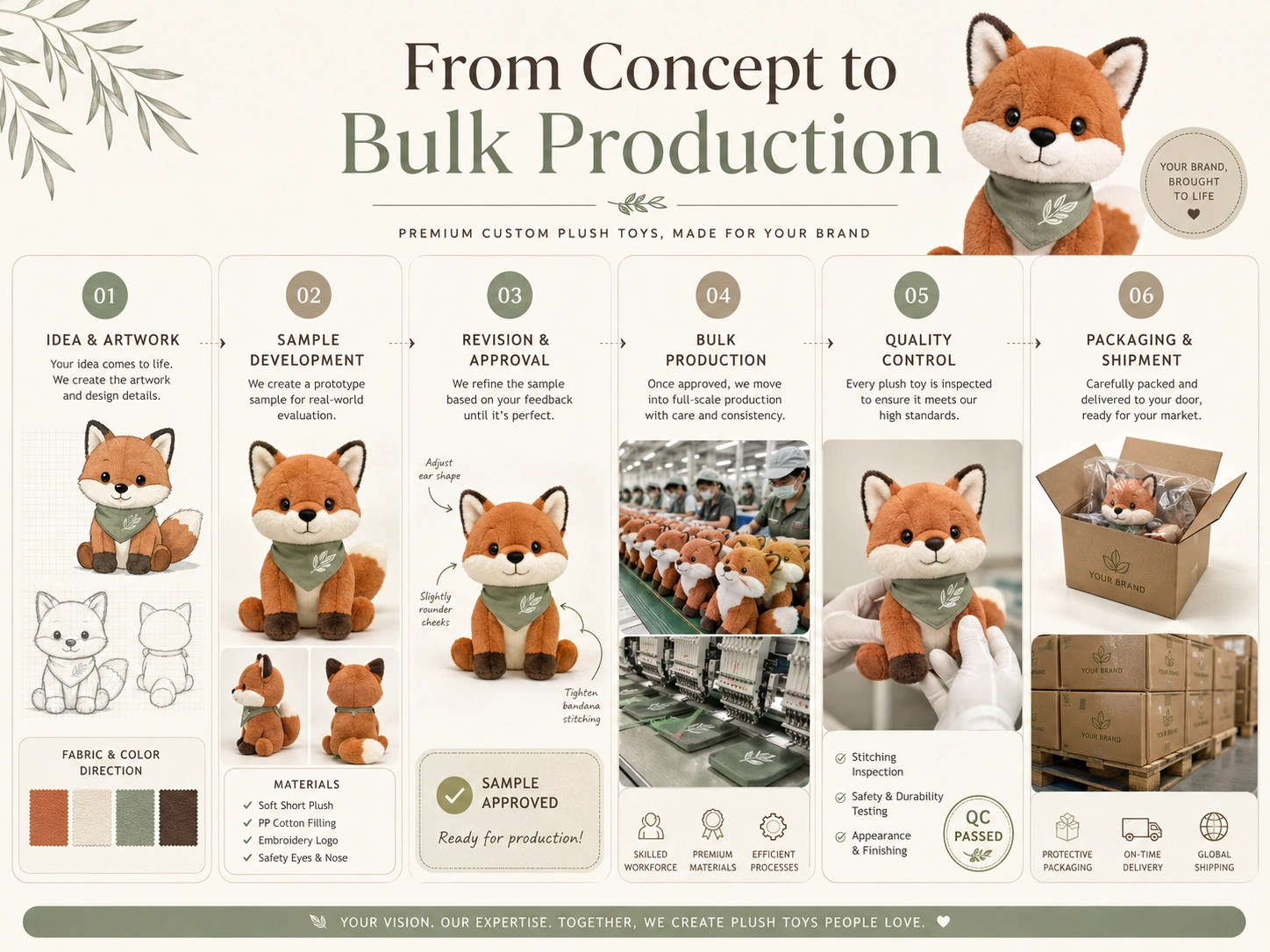
A private-label project is a product system: plush, branding, packaging, carton data and reorder files must work together.
Private Label Plush Reorder Planning: SKU, Packaging and Warehouse Control
Private-label plush is a complete product system: the plush, labels, hangtags, packaging, carton information and reorder files must be planned together. Approve the branding and packing direction on the sample before bulk release.
Start with a commercial brief
Before requesting a sample, define the customer, retail channel, target price range, destination market, launch window and expected quantity per design. These commercial decisions influence size, fabric, accessory complexity and packaging more than a mood board alone.
Build a focused SKU structure
| Decision | Why it matters | First-order approach |
|---|---|---|
| Number of designs | The MOQ is 3,000 pieces per design, with its own pattern and sample | Prioritize the strongest design or a small coordinated range |
| Size architecture | Controls price points, shelf space and carton efficiency | Use a clear core size and optional mini add-on |
| Brand system | Labels, colors and packaging should stay consistent | Approve logo files and placement before sampling |
| Reorder plan | Strong and weak SKUs should not be replenished equally | Keep specifications and packaging files by SKU |
Put branding into the complete sample
The approved sample should include the intended woven or printed label, care label position, hangtag direction and key packaging elements. Approving the plush body first and deciding brand presentation later can create avoidable changes to seams, label positions and packing.
Confirm the packaging hierarchy
- Product label and care information
- Hangtag or retail card with barcode space
- Individual protection such as a bag or tissue wrap
- Gift box or display pack where required
- Inner pack, outer carton, SKU and carton marks
Custom printed packaging may have a different MOQ from the plush product. Review packaging supplier conditions before promising a first-order configuration.
Release bulk production with one controlled specification
Record approved measurements, colors, fabrics, embroidery, accessories, labels and packaging. Changes after bulk release should be documented because they can affect cost, schedule, quality control and compliance planning.
Prepare warehouse and reorder information
Retailers should retain the approved sample, artwork versions, packaging files, pieces per carton, carton dimensions, gross weight and SKU marks. After launch, compare sell-through by design and reorder the strongest items rather than duplicating the first assortment automatically.
What controls a private label plush production process?
The private label plush production process connects the approved plush sample with brand labels, hangtags, packaging files, SKU data and repeat-order records. Buyers planning private label plush from concept to shelf should lock these details before bulk release.
TGS starts this process with 3,000 pieces per design and complete front, side and back artwork with dimensions.
Continue your private-label plan
Continue to the relevant sourcing page
Review product options, manufacturing support and quotation requirements for this project route.
Open the relevant sourcing page →Planning a private-label plush launch?
Send the designs, quantity per SKU, brand files, packaging direction, target market and launch timing for a complete project review.