TGS factory project fit · Updated August 29, 2026
Toy Gift Supply is a bulk custom plush manufacturer for established brands, retailers, licensed programs and funded merchandise projects. Our standard MOQ is 3,000 pieces per design.
- Required before quotation or sampling: front, side and back views with finished dimensions.
- A single AI-generated image may show the concept, but it is not a production-ready drawing.
- Buyers must own the original character or have authorization to manufacture it.
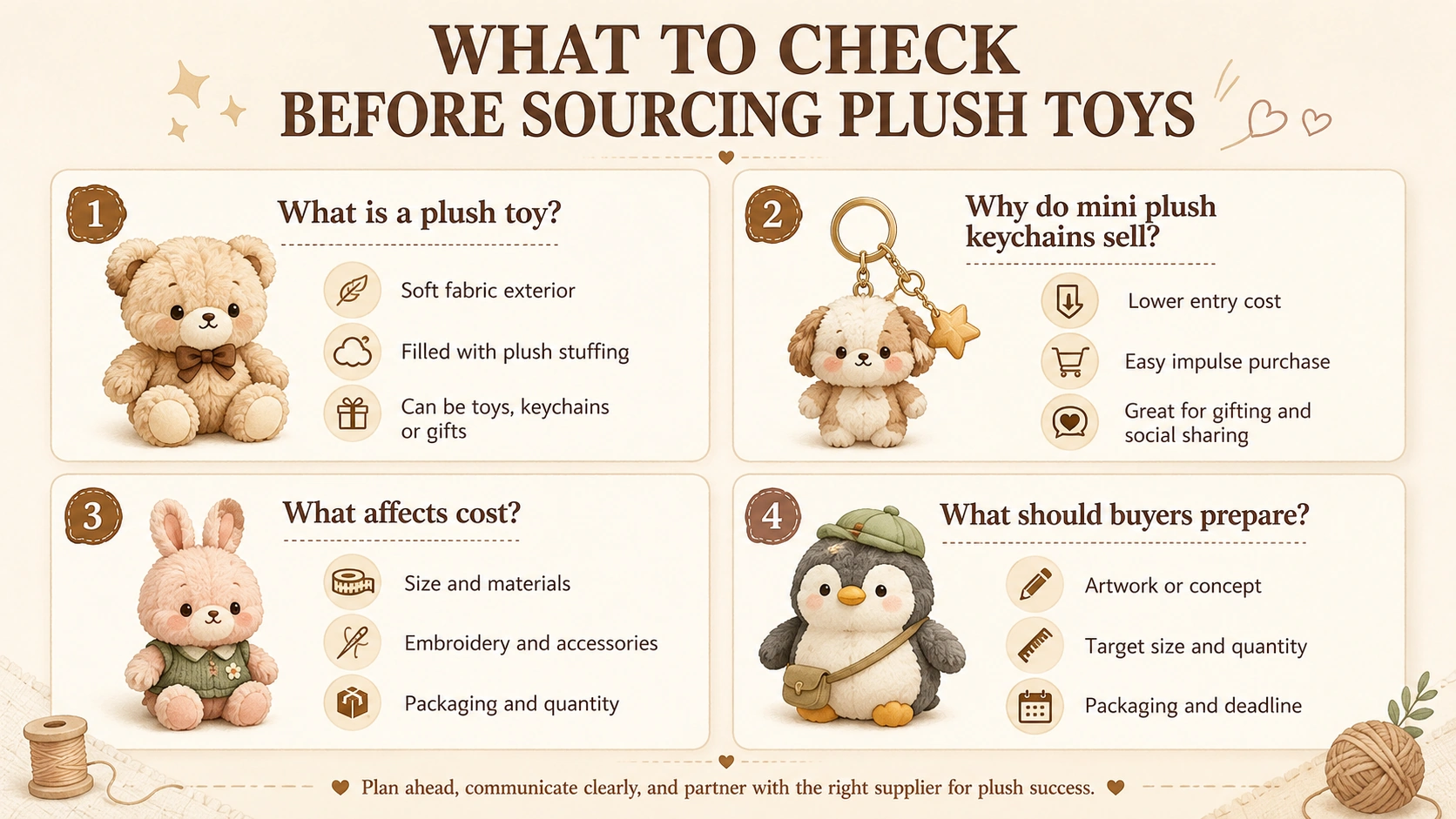
A useful supplier comparison measures how well each company can control your exact project—not how many generic product photos it displays.
How Retail Buyers Compare Plush Toy Suppliers: A Practical Scorecard
Compare plush suppliers on the same project specification. Score sampling, manufacturing evidence, revision control, packaging, quality checks and repeat-order records instead of choosing only by generic product photos or the lowest initial price.
Start with project fit
A supplier that is suitable for ready-stock wholesale may not be the best choice for an original mascot, private-label range or mini plush keychain. Define whether you need custom development, buyer-owned IP, private-label packaging, selected licensed products or available non-exclusive styles before comparing quotations.
Use a weighted supplier scorecard
| Area | Evidence to request | Buyer question |
|---|---|---|
| Sampling | Clear revision process and complete sample photos | How are shape, embroidery and material changes recorded? |
| Manufacturing | Factory process information relevant to the project | Which work is controlled directly and which is sourced? |
| Specification control | Measurements, material references and approved details | What document releases bulk production? |
| Packaging | Label, hangtag, bag, box and carton planning | Does custom packaging have a separate MOQ? |
| Quality control | Incoming, inline and final inspection route | How are bulk differences handled before shipment? |
| Reorders | Retained files and repeat-order identification | How will the approved SKU be reproduced later? |
Compare quotations on the same specification
A low price is not meaningful when suppliers are quoting different sizes, fabrics, embroidery, filling, labels or packaging. Send one brief to each supplier and ask them to state assumptions and exclusions. Confirm whether sampling, packaging setup, testing, freight and duties are included or separate.
Evaluate communication during sampling
Sampling is a practical test of project management. A reliable process identifies missing views, explains manufacturability limits, records revisions and asks for approval before bulk production. Repeated generic replies or unexplained changes are more important warning signs than polished marketing language.
Verify claims without requesting confidential customer IP
Buyers can review factory photos, process descriptions, sample documentation and project-specific evidence without asking the supplier to disclose another customer’s protected designs. For licensed or buyer-owned characters, confirm the applicable rights and approved market scope.
Finish with commercial readiness
- MOQ and quantity per design are clear.
- Sample fee, revision scope and timing are understood.
- Packaging and labeling responsibilities are assigned.
- Destination-market preparation is discussed.
- Payment, production release and shipment documents are confirmed.
Supplier Scorecard for Repeat B2B Orders
A reliable custom plush toy manufacturer should score well on sample accuracy, specification control, communication, QC and repeatability—not only on the first unit price. A custom plush supplier for gift companies also needs to handle seasonal delivery and presentation packaging, while a custom plush wholesale supplier should keep stable carton and SKU records for repeat orders.
How should buyers screen a plush toy supplier for bulk production?
A plush toy supplier evaluation should verify the factory route, sample control, written specifications, QC records, packaging and repeat-order process. Buyers comparing an OEM plush toy factory should also qualify its volume range instead of sending the same RFQ to both artisan and mass-production suppliers.
TGS is the mass-production route: 3,000 pieces per design, complete three-view drawings with dimensions and confirmed character rights.
Continue supplier evaluation
Continue to the relevant sourcing page
Review product options, manufacturing support and quotation requirements for this project route.
Open the relevant sourcing page →Comparing plush toy suppliers?
Send one project brief with the artwork, size, quantity per design, market, packaging and timing so the quotation assumptions can be compared fairly.