TGS factory project fit · Updated September 5, 2026
Toy Gift Supply is a bulk custom plush manufacturer for established brands, retailers, licensed programs and funded merchandise projects. Our standard MOQ is 3,000 pieces per design.
- Required before quotation or sampling: front, side and back views with finished dimensions.
- A single AI-generated image may show the concept, but it is not a production-ready drawing.
- Buyers must own the original character or have authorization to manufacture it.
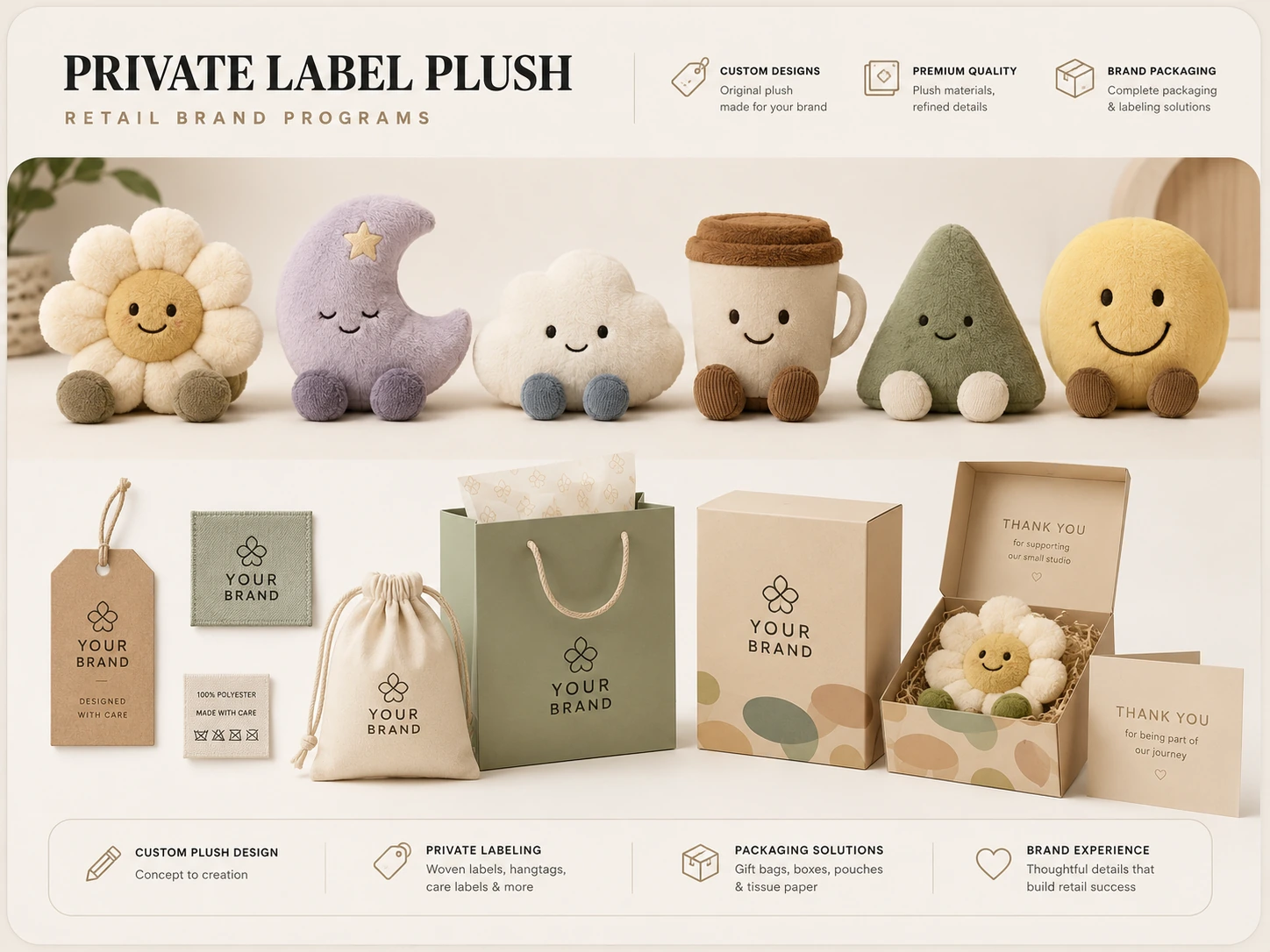
Private label plush combines product development, brand identification, packaging and market-specific documentation.
What Is a Private Label Plush Toy?
A private label plush toy is produced for the buyer’s own brand and sold with buyer-controlled branding, labels and packaging. The product may be developed from original artwork, adapted from a buyer-owned mascot or built around an agreed non-infringing concept.
Private label is not the same as licensed character merchandise. A third-party character cannot be turned into a private label product merely by changing the hangtag. Rights and market authorization must be handled separately.
Seven Decisions to Make Before Requesting a Sample
| Decision | What to prepare | Why it matters |
|---|---|---|
| Target buyer | Age group, retail channel and intended use | Guides design, packaging and compliance planning. |
| Product concept | Artwork, reference images, size and key features | Allows the factory to evaluate construction and cost. |
| Brand assets | Logo files, brand colors, fonts and label wording | Prevents late changes to tags and packaging. |
| Order plan | Quantity per design and expected reorder volume | Our standard MOQ is 3,000 pieces per design. Product specifications and packaging are confirmed during project review. |
| Packaging | Hangtag, woven label, bag, backing card or box | Packaging suppliers may have separate print setup or material requirements. |
| Target market | Country, age grading and importer requirements | Testing, labels and warnings depend on the market. |
| Approval process | One person responsible for sample and copy approval | Reduces conflicting revisions and delays. |
MOQ and SKU Planning
Toy Gift Supply’s standard MOQ is 3,000 pieces per design. Product specifications and packaging are confirmed during project review. For a first launch, it is usually safer to focus on fewer well-developed designs than to divide the budget across too many small SKUs. Every additional character needs its own pattern, sample approval and bulk quality control.
If several designs use the same fabric and packaging format, some materials can be planned together, but the MOQ is 3,000 pieces per design. Printed packaging may also create a separate print setup or material requirement that should be confirmed before the sample is finalized.
Build Branding into the Sample
- Woven or printed brand label
- Care label and required product information
- Hangtag with barcode or retail copy
- Backing card, bag or gift box
- Carton labels and SKU identification
- Online and in-store presentation requirements
Approving a plain plush sample first and adding branding later can create fit, color and packaging problems. The preferred approach is to review the product and its key retail presentation together.
Sample Approval Before Bulk Production
Check the overall silhouette, dimensions, fabric direction, embroidery placement, seam shape, stuffing firmness, label position and packaging fit. Record approved measurements and reference photos so bulk inspection can be compared against the same standard.
A private label supplier should also explain which details are stable in mass production and which handmade tolerances are realistic. This is more useful than promising that every piece will look mathematically identical.
Compliance and Market Responsibility
The buyer should identify the destination market and product classification before production. Testing reports, labels and declarations must match the actual product and applicable requirements; a generic certificate from an unrelated style is not enough.
For U.S. or EU projects, importers and brand owners should confirm their own certification, labeling and record-keeping responsibilities with a qualified compliance adviser.
Plan the Reorder Before the First Shipment
Keep approved samples, color references, packaging files, carton specifications and SKU records organized. When a product sells well, the reorder should reproduce the approved specification rather than restart development from memory.
A real retail use case: custom graduation bear gifts for Malaysian florists
A retailer planning a graduation gift range can commission an original cap-and-gown plush as the keepsake component of a florist-assembled bouquet. The factory brief should specify the plush dimensions, cap attachment, brand label, colors, quantity per unique design and the date the plush must reach the Malaysian assembly partner. Our standard MOQ remains 3,000 pieces per design; fresh flowers and local individual gift delivery are separate services.
Compare the Malaysia graduation plush bouquet wholesale guide with our private-label plush manufacturing service before approving the assortment.
How do retail brands start a private label plush toy line?
Buyers researching how to start a private label plush toy line need one approved character direction, a retail channel, SKU plan, labels, packaging and reorder logic. A private label plush launch should move from production-ready artwork to sample approval before the 3,000-piece-per-design bulk order.
Brand mood boards and AI concepts can support discussion, but they do not replace the front, side and back drawings required for an OEM plush project.
Move from planning to factory review
Once your character direction, sales channel and packaging plan are clear, explore our private-label capabilities and factory process. Planning 3,000 or more pieces per design? Share your production drawings and project details for a factory review.
FAQ: Starting a Private Label Plush Line
What is the MOQ for private label plush toys?
Our standard MOQ is 3,000 pieces per design. Product specifications and pricing depend on construction, materials, branding, packaging and market requirements.
Can I add my logo to an existing-looking plush style?
A brand can use original or properly controlled designs. The project must not copy a protected third-party character or distinctive product without permission.
What branding options are available?
Options can include woven labels, printed labels, care labels, hangtags, backing cards, bags and retail boxes, subject to the project specification.
Should packaging be approved with the sample?
Yes. Key label placement, hangtag size and package fit should be reviewed before bulk production whenever possible.
What information is needed for a quote?
Send artwork, size, quantity per design, target country, sales channel, branding files, packaging request and launch timing.
Planning a Private Label Plush Line?
Send your product concept, quantity per design, target market and branding requirements for a practical project review.