TGS factory project fit · Updated August 29, 2026
Toy Gift Supply is a bulk custom plush manufacturer for established brands, retailers, licensed programs and funded merchandise projects. Our standard MOQ is 3,000 pieces per design.
- Required before quotation or sampling: front, side and back views with finished dimensions.
- A single AI-generated image may show the concept, but it is not a production-ready drawing.
- Buyers must own the original character or have authorization to manufacture it.
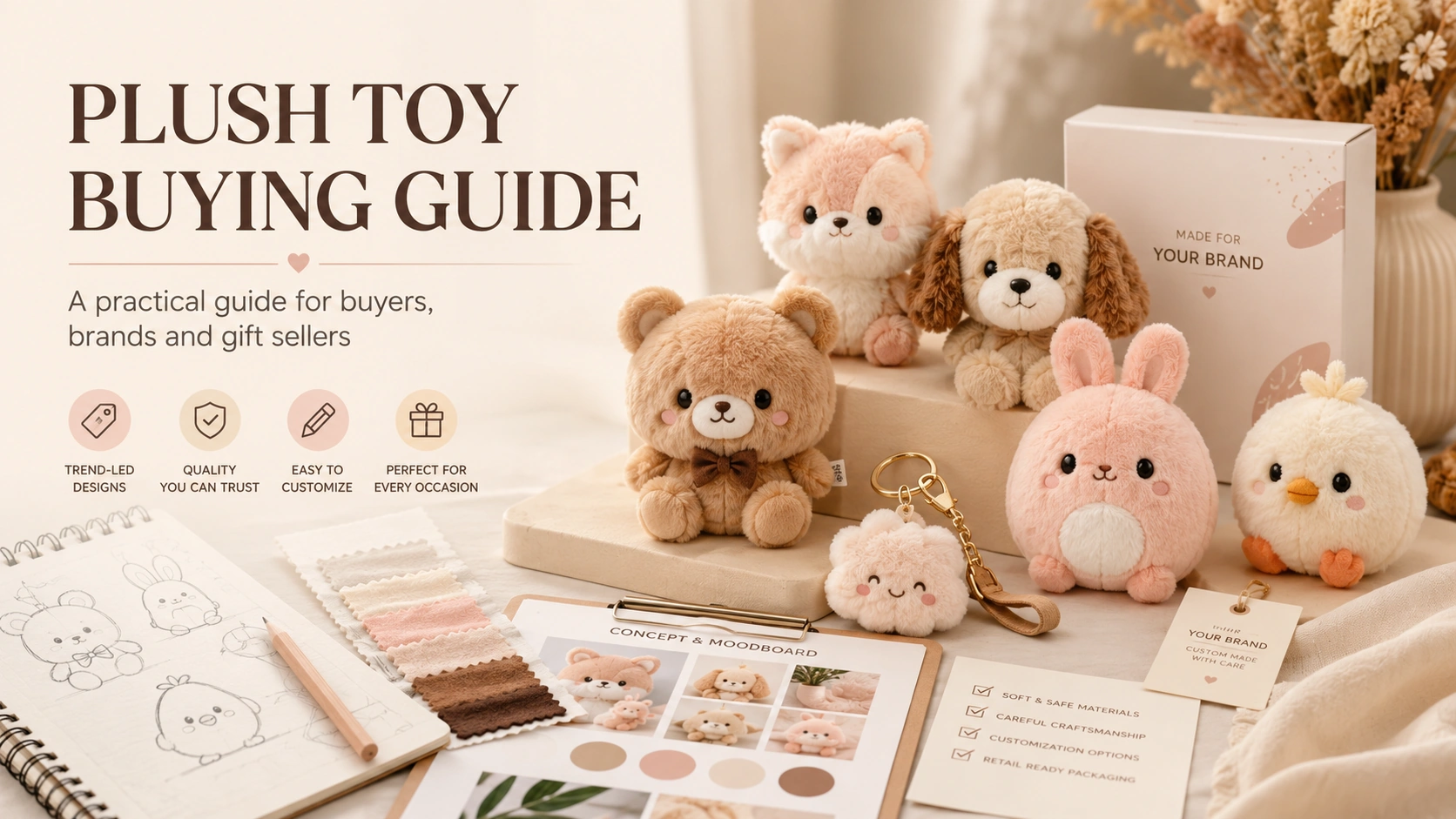
A useful quotation starts with a production brief, not only a reference photo.
What is the safest way to buy custom plush toys from China?
Define the product, target market, quantity per design, packaging and arrival date; compare suppliers using the same specification; develop and approve a physical sample; then lock materials, measurements, labels, packaging and quality checkpoints before bulk production. Toy Gift Supply's standard MOQ is 3,000 pieces per design. Product specifications and packaging are confirmed during project review.
First choose the right sourcing route
| Route | Use it when | Main preparation |
|---|---|---|
| Custom OEM plush | You own an original character, mascot or product concept | Artwork, size, details, quantity and target market |
| Private-label plush | You need branded labels, hangtags and retail packaging | Brand files, packaging copy, barcode needs and SKU plan |
| Wholesale assortment | You need a faster retail test using existing product directions | Store type, price tier, quantities and reorder expectations |
| Licensed plush | You are buying an authorized product for an approved territory | Buyer identity, market, channel and authorization scope |
Prepare a project brief a factory can evaluate
A reference image is useful, but it does not answer production questions. The factory needs enough information to estimate complexity, sampling work, material use, packaging and production feasibility.
- Front, back and side artwork or reference images
- Target finished size and measurement method
- Quantity per design, color or SKU
- Fabric, embroidery, printing and accessory requirements
- Target market and intended age group
- Labels, hangtags, bags, boxes and carton marks
- Required arrival date and preferred shipping route
Understand what changes the custom plush price
Price is affected by more than height. Two plush toys of the same size can have different fabric consumption, sewing time, embroidery count, clothing, accessories and packaging. Compare quotations only after the core specification is aligned.
| Cost driver | Examples | Buyer decision |
|---|---|---|
| Shape complexity | Separate limbs, 3D details, clothing and multiple panels | Decide which features are essential to recognition |
| Materials | Short pile, long pile, fleece, velboa and specialty fabrics | Approve the exact hand feel and color reference |
| Decoration | Embroidery, printing, appliqué and patches | Confirm size, position and color count |
| Accessories | Key rings, magnets, sound or light modules, removable parts | Review function, attachment and target-market implications |
| Packaging | Hangtags, cards, bags, gift boxes and display cartons | Balance presentation with packaging setup requirement and freight volume |
Use the sample to create one controlled specification
The physical sample confirms whether flat artwork can become a stable three-dimensional product. Record the approved size, fabric, color, embroidery, filling, accessories, labels and packaging. Ask for revision notes to be consolidated so both sides work from the same final version.
Verify the supplier with project evidence
- Can the supplier explain how the sample will be developed?
- Can it show relevant factory processes without exposing confidential customer IP?
- Does the quotation identify the product specification and exclusions?
- Are packaging and quantity per design discussed early?
- Is there a defined sample approval and bulk quality-control process?
- Can repeat-order material and artwork records be maintained?
Lock packaging, inspection and shipping before production
Final packaging affects product protection, carton size and warehouse handling. Confirm pieces per carton, carton marks, barcode placement and whether mixed cartons are allowed. Bulk production should be checked against the approved sample and specification, with agreed inspection points for appearance, seams, embroidery, accessories, labels and packing.
How to Compare a Custom Stuffed Animal Supplier in China
A buyer evaluating a custom stuffed animal supplier China project should compare the same production brief across factories: character artwork, finished size, fabrics, embroidery, filling, accessories, packaging, quantity and destination market. This makes supplier comparisons more useful than comparing headline unit prices alone.
Continue your custom plush sourcing plan
Ready to request a custom plush quotation?
Send the artwork, target size, quantity per design, destination market, packaging and required arrival date.