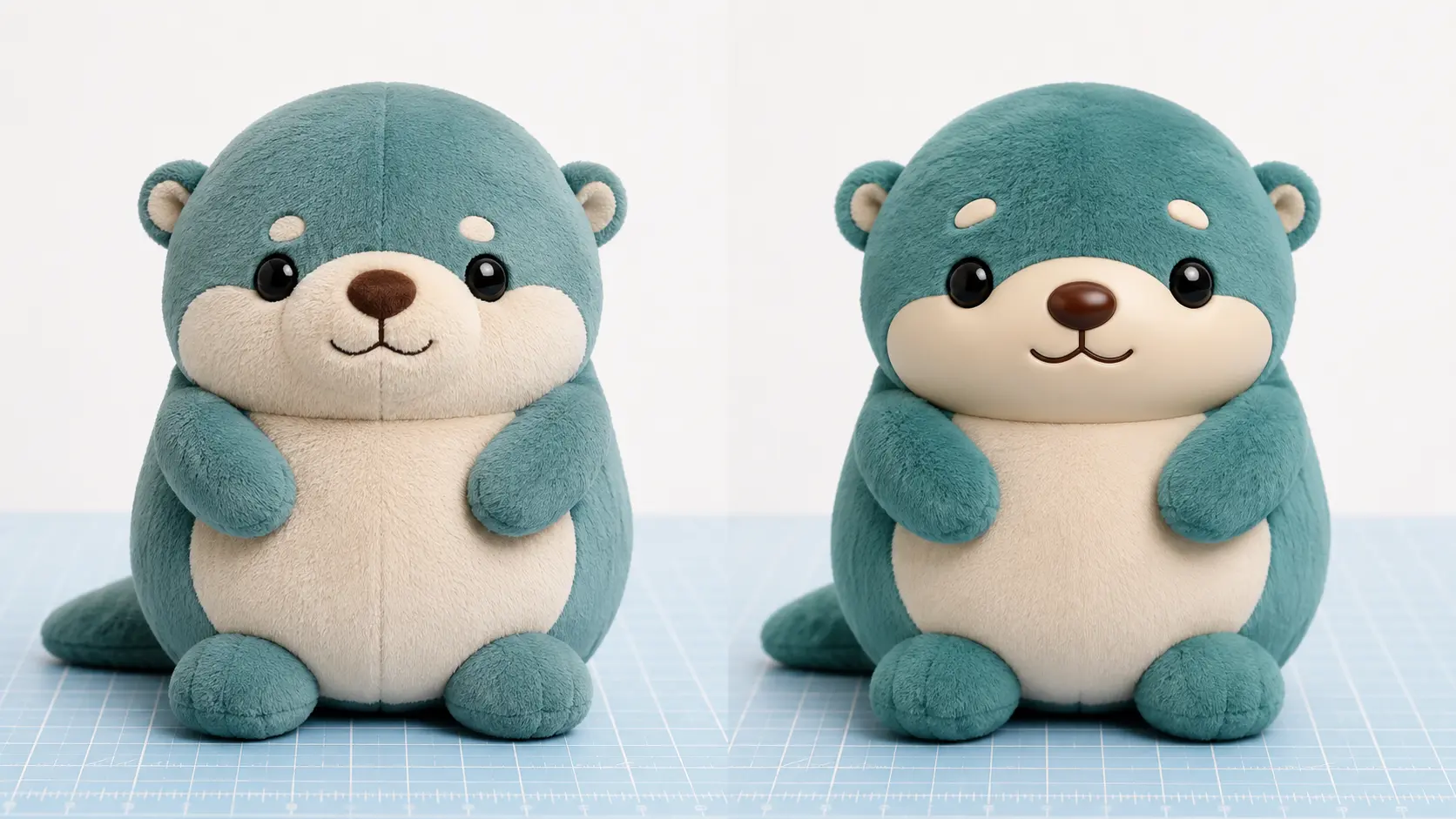
The left product is textile and stuffing throughout. The right product adds a smooth molded face component, so it requires a different factory capability and development route.
Why “Labubu-Like Plush” Is Often the Wrong Product Description
Buyers frequently send a front-facing AI image and ask for a “plush toy like Labubu.” The construction they have in mind is often not a pure plush toy. POP MART officially uses names such as Vinyl Plush Pendant and lists material combinations including PVC and polyester for some THE MONSTERS products. In manufacturing terms, this is a vinyl-plush hybrid: a molded face or head combined with a soft textile body.
This distinction matters before quotation. A plush pattern maker works with fabric panels, seam lines, embroidery and stuffing. A vinyl specialist works with a digital sculpt, mold split, wall thickness, molded shell, surface color and assembly points. The two suppliers may cooperate in one finished product, but the development work is not interchangeable.
Toy Gift Supply currently focuses on sewn all-plush toys and does not make molded vinyl faces, heads or bodies. We also do not reproduce Labubu or any other protected character without valid authorization. Use the comparison in this guide to identify your construction—not to request a copy of another brand’s character.
Vinyl Plush vs All-Plush: The Production Difference
| Decision | All-plush toy | Vinyl-face / vinyl-plush hybrid |
|---|---|---|
| Main construction | Fabric panels, embroidery or printing, filling and sewing | Molded vinyl face or head plus a sewn textile body |
| Core design file | Consistent front, side and back turnaround; size and detail notes | Approved 3D sculpt or CAD file plus textile-body artwork |
| Development work | Pattern making, fabric selection, embroidery setup and physical sampling | 3D engineering, mold design, tooling, molding trials, color/paint review and assembly sampling |
| Rigid product mold | Usually no, when every visible component is sewn textile | Yes, for the molded vinyl component |
| Cost profile | Sample and pattern-development costs; changes are usually handled through pattern and material revisions | Higher upfront development risk because sculpting, tooling and mold revisions are added before bulk production |
| Toy Gift Supply fit | Yes, subject to artwork, sample and project review | No; a vinyl or collectible-toy specialist is required |
One exception: an otherwise all-plush product may still use molded eyes, noses, clips or decorative accessories. Those parts can introduce separate tooling, safety and attachment requirements. Confirm every hard component before treating the project as all-plush.
What Our Plush Pattern Maker Actually Needs
For a sewn plush toy, the phrase “3D drawing” can cause confusion. A pattern maker usually does not need a full CAD model. The practical starting file is a three-view character turnaround: front, side and back views showing the same character at the same scale and with the same proportions.
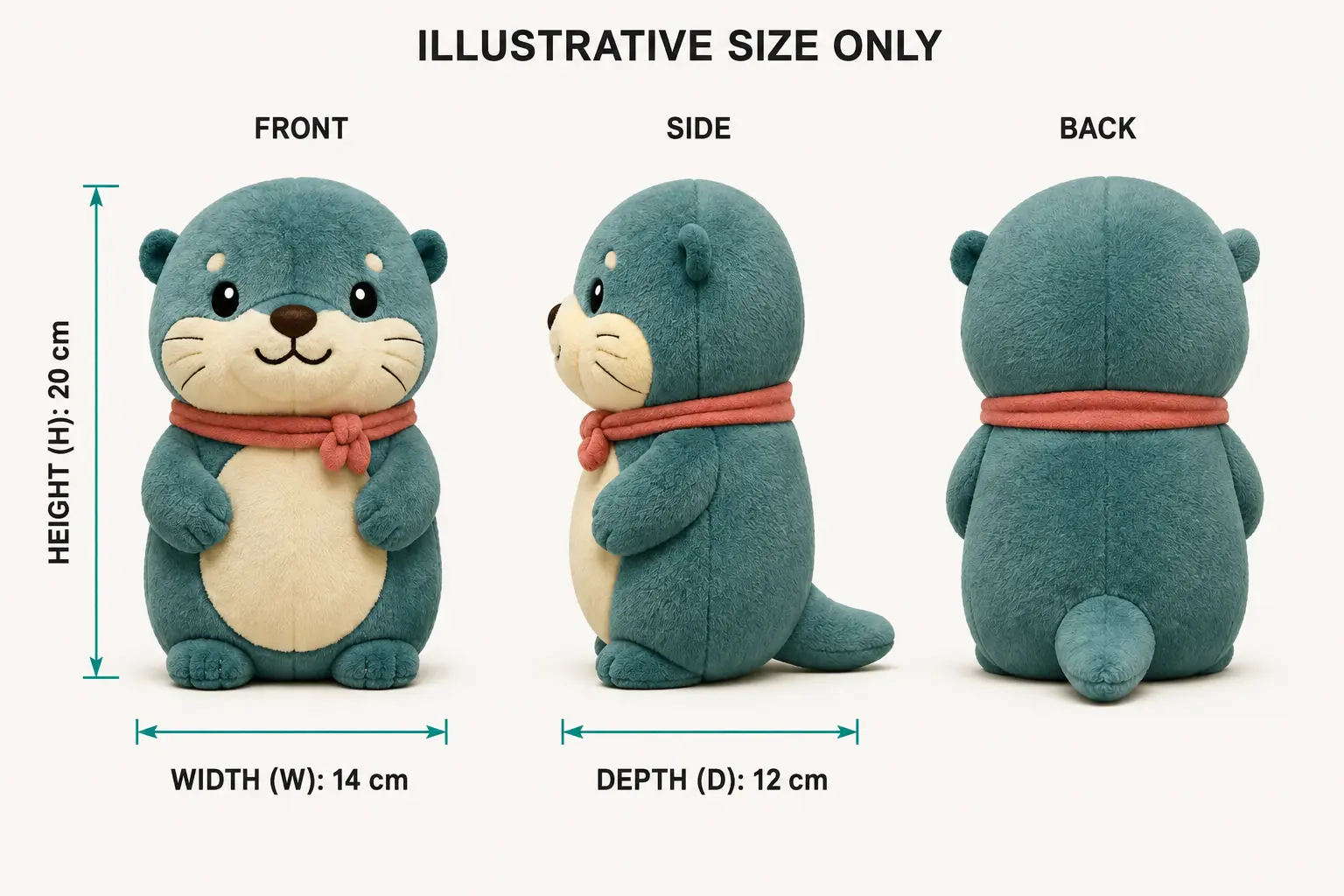
Illustrative size only: H 20 cm × W 14 cm × D 12 cm. A useful turnaround keeps the head-to-body ratio, tail, ears, colors, clothing and small details consistent in all three views. Your project must state its own target finished dimensions.
How to mark the finished size
Write all three measurements in centimeters and state whether the toy is measured sitting or standing. Measure height (H) from the lowest supporting point to the highest point, width (W) across the widest front-view points, and depth (D) from the frontmost to the backmost point in the side view. State separately whether a tail, hanging loop, keychain or removable accessory is included in the measurement.
- Front view: facial layout, body proportion, limb placement, embroidery and the main expression.
- Side view: head depth, muzzle projection, ear thickness, sitting or standing posture, tail shape and garment layers.
- Back view: rear seams, tail attachment, clothing closure, color blocks and any back embroidery or labels.
- Project details: target finished size, Pantone or approved color references, material direction, quantity per design, destination market and packaging request.
- Rights confirmation: original character ownership or valid authorization for any licensed artwork.
Toy Gift Supply’s standard MOQ is 3,000 pieces per design. Product specifications, materials, accessories and packaging are confirmed during project review.
Why One AI Image Is Not a Production File
An AI image can communicate mood, color and a general character idea. It does not automatically define a manufacturable object. A polished front render may hide the exact information the sample room needs:
- the back may not exist at all;
- the left and right sides may be different without intention;
- ears, fingers, accessories or garment details may change between generated views;
- lighting and gradients may be impossible to match with available fabric;
- there may be no clear seam, embroidery or attachment decision;
- the design may unintentionally imitate protected character features;
- the character may look balanced in an image but fall over as a physical product.
For these reasons, Toy Gift Supply does not accept a single AI-generated image as the final production drawing. If AI was used during concept exploration, a designer must still resolve the character into one consistent, approved turnaround. Do not send three separately generated AI images and assume they form a three-view sheet; the views must describe the same physical object.
When a Real 3D Sculpt and Mold Are Required
If the design includes a smooth sculpted vinyl face, head or body, a toy specialist must turn the approved character into a controlled 3D model. The 3D file is then reviewed for the molding process, including the parting line, openings, undercuts, wall thickness, shrinkage, finishing and connection to the textile body.
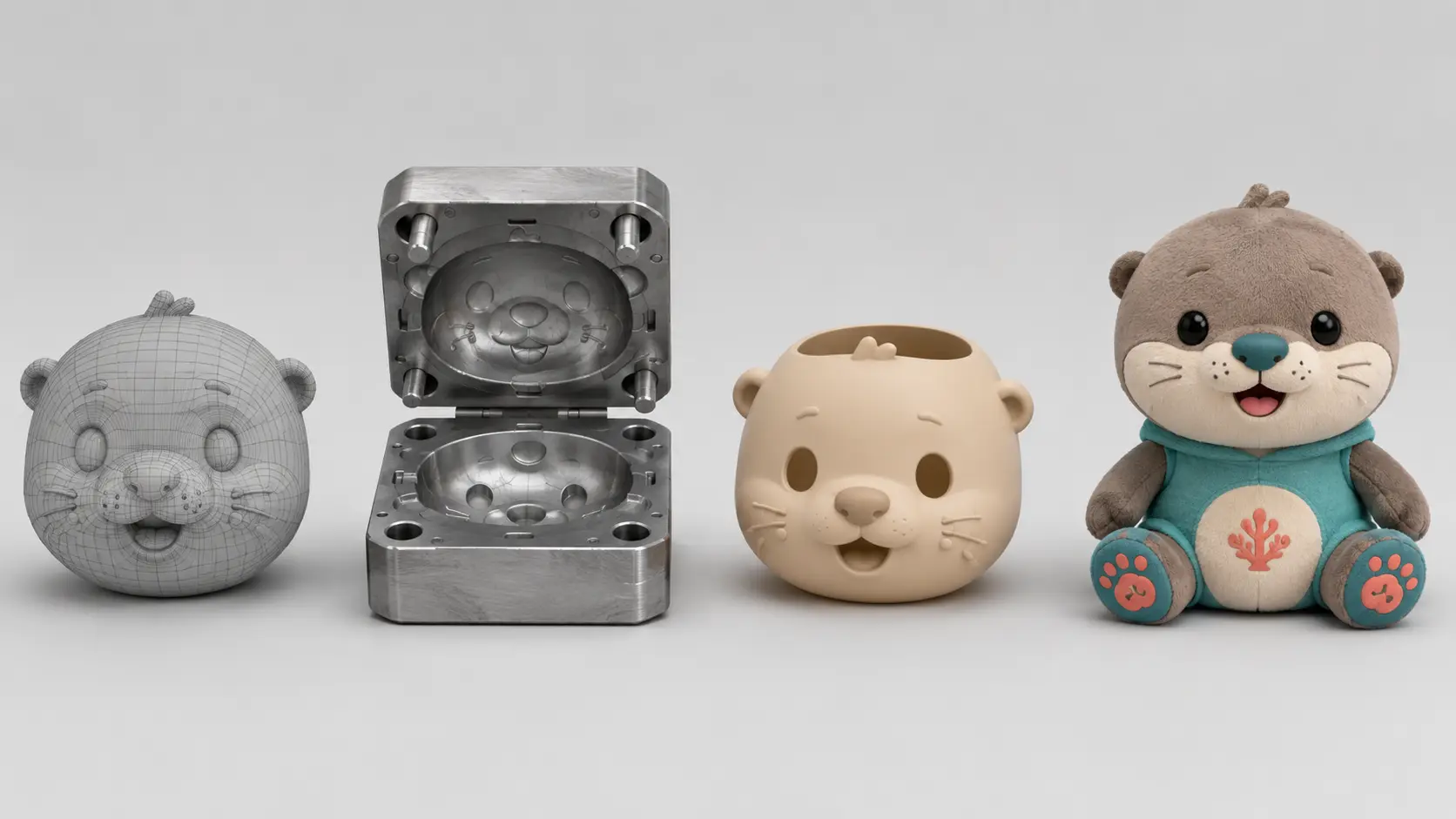
Simplified visual sequence: digital sculpt → tooling → molded hollow shell → assembly with a plush body. The exact production method and file format must be confirmed with the selected vinyl specialist.
The Association of Rotational Molders explains that rotational molding uses a closed mold and continuous rotation so material coats the inside surface; its design guidance also describes the use of 3D CAD in product and tooling development. This is why a vinyl component cannot be developed like a sewn plush sample. Tooling adds upfront cost, and changing the sculpt after the mold is made can be expensive.
Toy Gift Supply does not quote this molded component. If your concept requires PVC, soft vinyl, silicone, resin or another hard sculpted face, work with a qualified collectible-toy or vinyl-toy specialist before asking a plush factory to develop the textile portion.
Use This Two-Minute Project-Fit Check
It is an all-plush project if…
The face, head and body can be made from fabric, embroidery, appliqué, printing and filling, with no molded sculptural shell.
It is a vinyl-plush project if…
The face or head must be a smooth shaped shell with sculpted cheeks, teeth, lips or facial depth that fabric and embroidery cannot create.
Send an all-plush inquiry to Toy Gift Supply only when you have:
- one original or authorized character;
- consistent front, side and back views;
- target finished size and pose;
- color, embroidery, fabric and accessory notes;
- quantity per design and destination market;
- packaging and label requirements;
- confirmation that the product does not require a molded vinyl face or head.
Frequently Asked Questions
Is a Labubu product a pure plush toy?
Not always. POP MART officially uses names such as “Vinyl Plush Pendant” and lists combinations including PVC and polyester for some products. That is a hybrid construction rather than an all-textile plush toy. Specifications vary by product.
Can Toy Gift Supply make a Labubu-like vinyl plush toy?
No. Toy Gift Supply currently makes sewn all-plush products and does not manufacture molded vinyl components. We also do not reproduce protected characters without valid authorization.
Do all-plush toys need a mold?
An all-textile plush toy normally does not need a rigid vinyl product mold. It still needs pattern development, sewing and a physical sample. Molded eyes, noses or accessories may require separate tooling.
Can you make a plush toy from one AI-generated image?
Not as a controlled production project. One AI image can be a concept reference, but it does not define the side, back, seams, attachments or exact proportions. We require a consistent front, side and back turnaround before pattern review.
What artwork should I send for a custom all-plush quote?
Send front, side and back views, target size, color references, material and embroidery notes, quantity per design, destination market and packaging needs. Standard MOQ is 3,000 pieces per design.
Sources and Terminology
Terminology was checked against POP MART’s official Vinyl Plush Pendant product information. The molding explanation is based on the Association of Rotational Molders process guide and its digital product and tooling guidance.
When a Drawing Is Enough—and When It Is Not
A custom plush from drawing project can move into sampling when the front, side and back information is consistent and the construction can be achieved with fabric, embroidery and sewn parts. A custom plush prototype manufacturer still needs dimensions and construction notes to turn that artwork into a measurable sample. If you are learning how to design a plush toy for manufacturing, separate production views from lifestyle or AI render images so the pattern maker can read the character clearly.
Continue with the correct all-plush route
Have an all-plush project with complete three-view artwork?
Send the front, side and back views, size, quantity per design, market and packaging request. We will first confirm that the construction fits our sewn-plush capability.