This guide is for brands planning bulk custom plush orders, rather than a universal care guide for a collector’s toy. TGS’s standard MOQ is 3,000 pieces per design. Packing suitability and any additional sampling scope are confirmed for the individual project.
Vacuum packing, light compression or uncompressed packing?
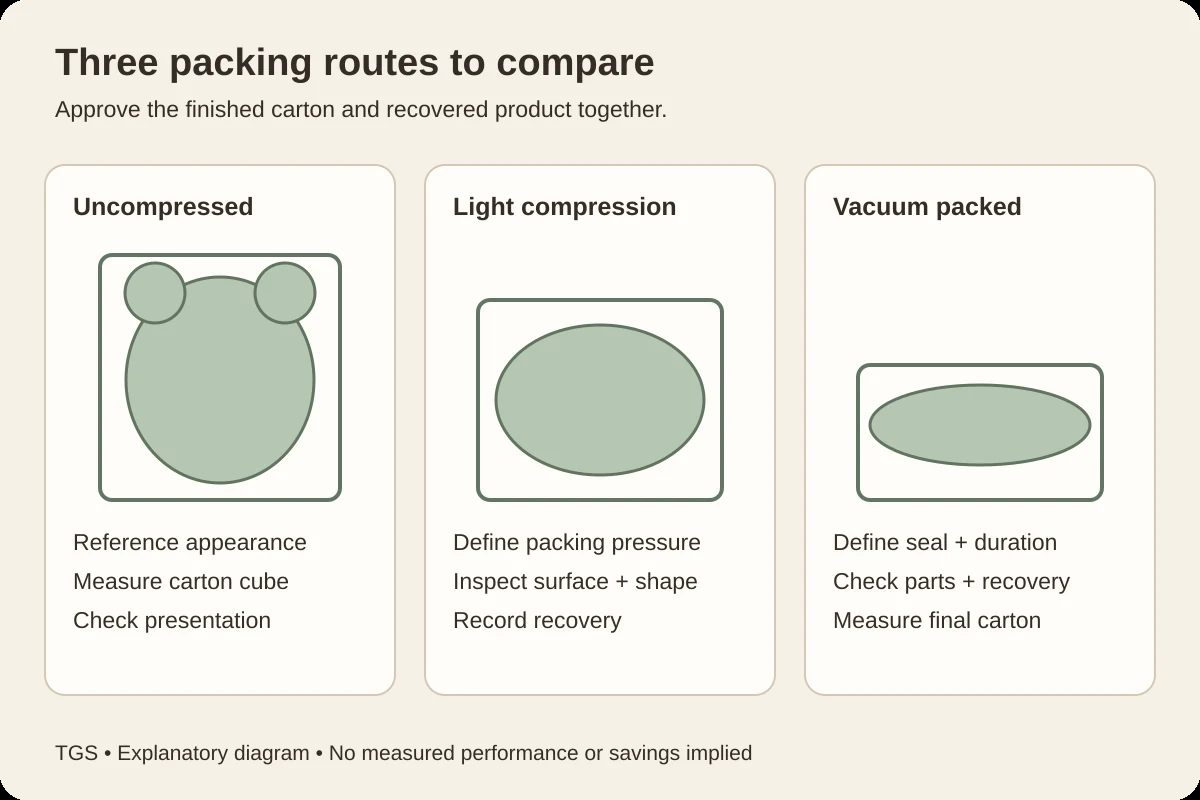
Separate a protective bag from a compression specification. “Packed in a bag” does not state how much air is removed, how the product is folded or how long it stays packed. Specify those details before comparing options.
| Route | What to define | What to verify |
|---|---|---|
| Uncompressed protective packing | Product orientation, individual protection, carton quantity and dividers if needed | Closed carton dimensions, movement inside the carton and retail presentation |
| Light compression | Allowed folding, pressure, bag closure and packed duration | Facial shape, pile direction, seams and recovery at agreed checkpoints |
| Vacuum packing | Bag specification, air-removal method, seal, arrangement and packed duration | Recovery, component contact, seal performance and actual carton space |
Keep a non-compressed reference sample available. If a design cannot meet the agreed appearance criteria after the trial, revise the packing configuration or select another route before approving bulk pack-out.
Which plush details need closer review?
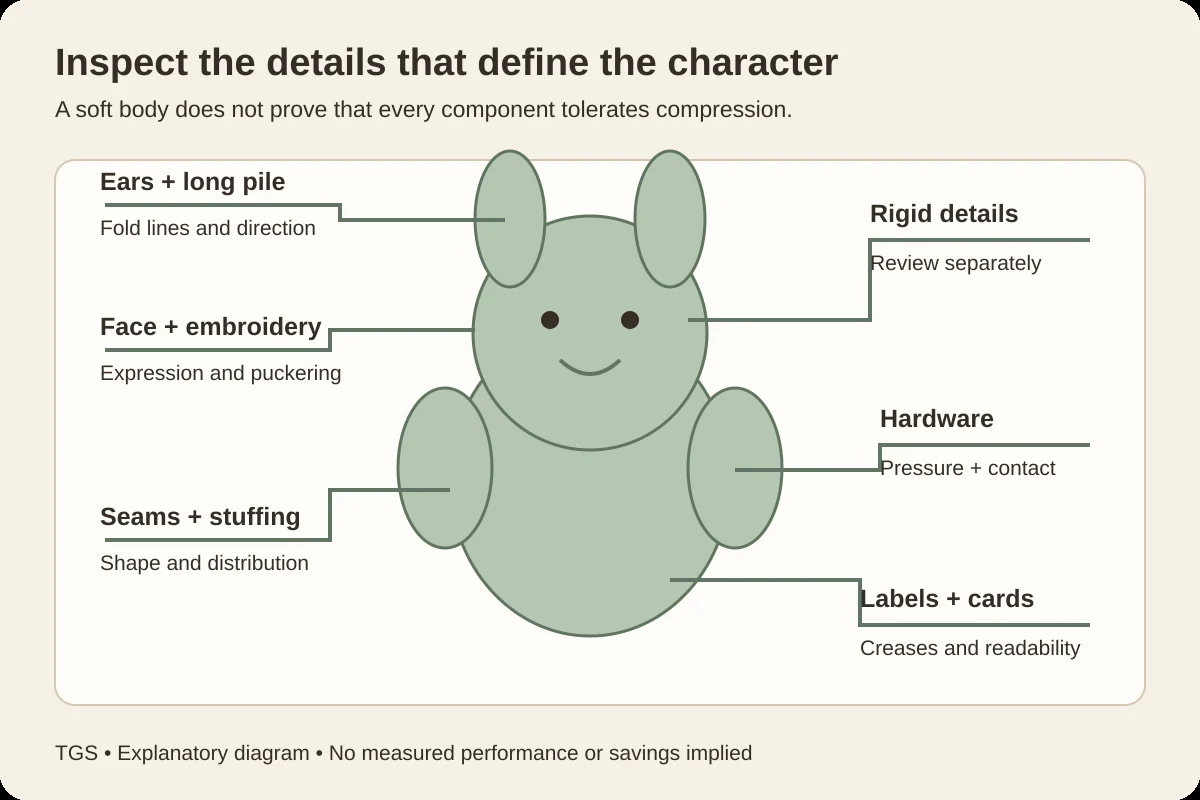
Use the following as inspection priorities, not as a pass/fail rule based only on appearance. The actual sample determines whether a specific configuration is acceptable.
| Detail | Question for the packing trial | Evidence to keep |
|---|---|---|
| Long pile, ears, tails and narrow limbs | Do folds or pile changes remain after the agreed recovery process? | Matching before/after photographs and viewing direction |
| Facial embroidery, appliqué and rounded head | Does the expression or head profile differ from the approved reference? | Front and side comparison at the same scale |
| Rigid or molded parts, electronics or internal structures | Can those components tolerate the proposed pressure and contact? | Component-specific review and agreed inspection; avoid assuming suitability |
| Keyrings, clips and other hardware | Does hardware press against the face, fabric, bag or neighboring units? | Attachment placement and approved protection or separation |
| Hangtags, backing cards and gift boxes | Are creases, damage or assembly steps acceptable to the sales channel? | Recovered retail pack and packing sequence |
For compact charms, include the finished hanging direction and attachment in the review. See the custom plush keychain and bag charm product page. For retail programs, compare the private-label plush and packaging requirements.
Does vacuum packing reduce plush shipping cost?
It can reduce the volume of some soft items, but the freight comparison must use the final packed shipment. DHL explains that package dimensions and actual weight can affect chargeable weight; the applicable calculation depends on the booked service. Do not apply one dimensional-weight divisor to every carrier or freight mode.
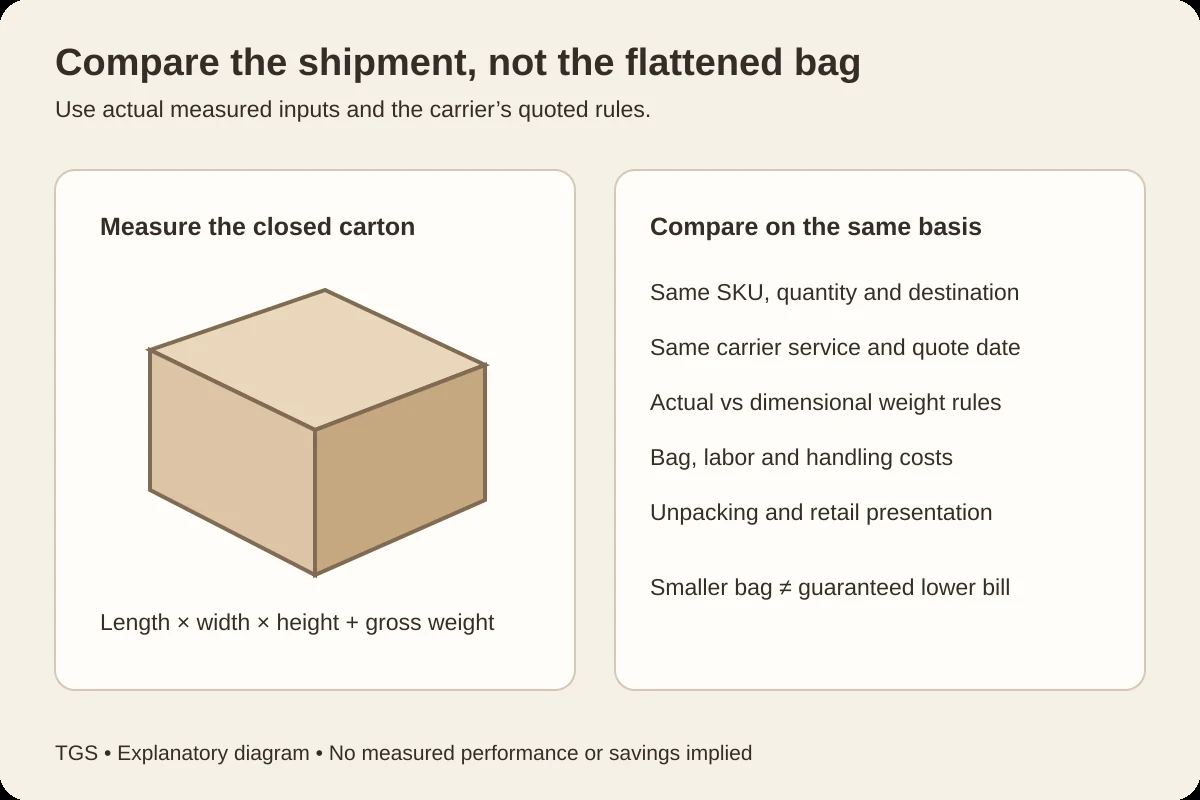
- Use the same SKU, number of units, destination and service for both quotes.
- Measure the closed outer carton after the intended packing process. Record gross weight and units per carton.
- Ask the forwarder for the applicable chargeable-weight or volume rules, surcharges and quote validity.
- Include packing materials, additional labor, destination unpacking, handling and any change to retail packaging.
- Approve appearance and packing suitability alongside the cost comparison.
A vacuum bag can form an irregular shape that leaves unusable carton space. Blackship’s own packing guidance highlights this limitation and notes that small quantities may not benefit. Its observations do not predict savings for a TGS order. Compare actual measurements rather than advertising a fixed percentage reduction.
How should a brand test shape recovery before bulk packing?
Agree the test plan with the factory before packing the sample. Define the construction revision, packing configuration, intended duration and likely transport/storage conditions. A short demonstration does not establish performance after a much longer journey.
- Record the baseline. Photograph front, side, back and detail views; record the agreed finished dimensions and sample ID.
- Document the pack. Identify the bag, method, fold positions, hardware protection, carton arrangement and time sealed.
- Open safely. Keep sharp tools away from the product. Follow the approved material-specific unpacking instructions.
- Review recovery. Use checkpoints agreed before the trial and compare the silhouette, expression, pile, seams, components and packaging with the baseline.
- Resolve exceptions. Record defects, required rework and the decision to approve, revise and retest, or choose another packing route.
There is no universal recovery time promised here. Do not use heat, steam, a dryer or forceful reshaping unless the product-specific care instructions and factory review support it. Appearance recovery is also separate from product-safety compliance and transport qualification.
A packing approval record buyers can copy
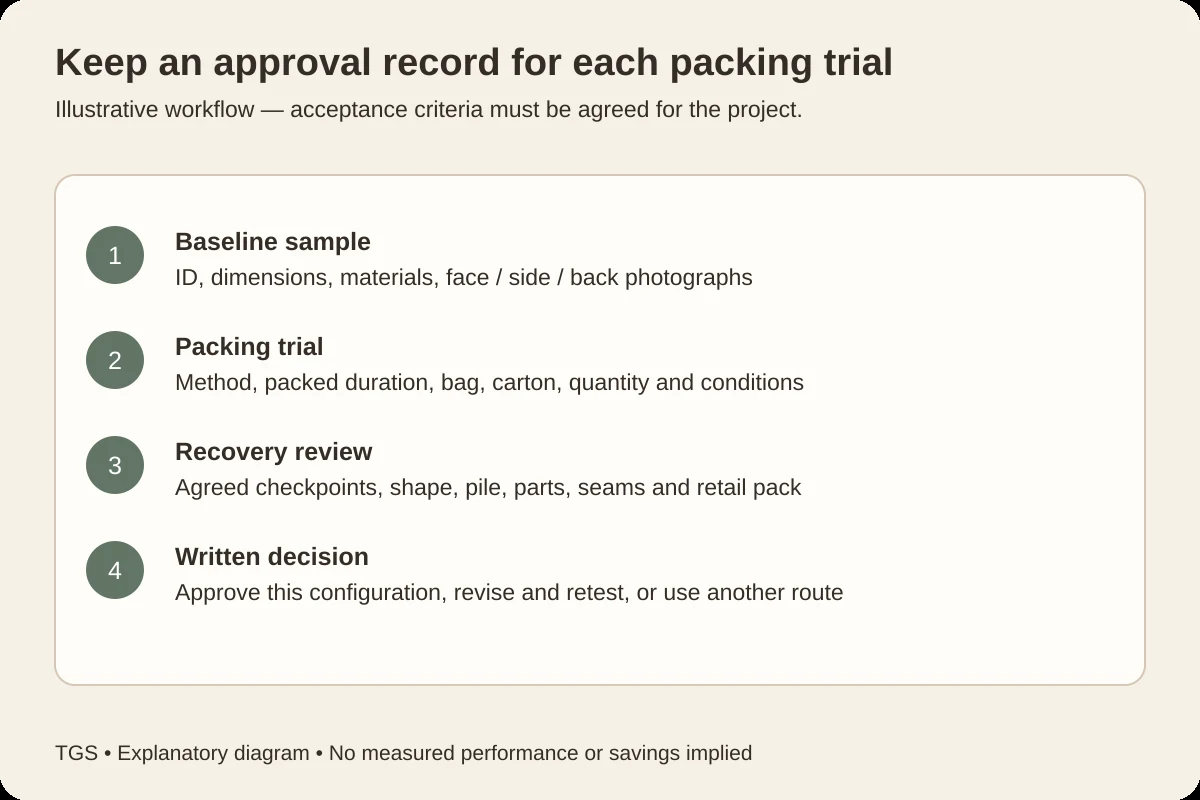
The fields below form a blank review template. They are not measured TGS test results.
| Record | Information to enter for the actual trial |
|---|---|
| Product and sample revision | SKU, artwork revision, sample ID, materials, finished dimensions and approver |
| Packing configuration | Method, bag specification, fold/orientation, component protection and packing photographs |
| Exposure | Packed duration and recorded conditions; explain differences from the planned shipping route |
| Shipment measurements | Units per carton, outer dimensions, gross weight, carrier service and quote date |
| Recovery criteria | Agreed checkpoints, recovery procedure and acceptable shape, pile, parts and packaging condition |
| Result and release | Actual observations, comparison photographs, exceptions, signed decision and approved pack-out revision |
If the material, filling, finished size, accessory, compression method, packed duration or carton arrangement changes, review whether the existing approval still applies. Carry the approved version into the factory-to-3PL packing handoff.
What should you send for a custom plush packing review?
Send production-ready front, side and back artwork with dimensions, quantity per design, construction and accessory notes, retail packaging requirements, destination, shipping mode and expected packed duration. The artwork preparation guide explains how to identify the design details that the sample must preserve.
Frequently asked questions
Can every stuffed animal be vacuum packed?
No blanket approval applies. Review the actual material, filling, shape, accessories and packing duration, then inspect a representative trial sample against agreed criteria.
Will the plush return to its original shape in 24 hours?
This guide does not promise a universal recovery period. Agree checkpoints and an acceptable appearance for the actual product before the trial.
Should hardware and retail cards be packed with the plush?
Review their placement, protection and potential contact in the actual configuration. Include the recovered retail presentation and any destination assembly in approval.
Is a smaller vacuum bag proof of lower freight cost?
No. Compare measured outer cartons, quantities, gross weight, carrier rules and the total packing and destination handling costs.
Sources and evidence boundary
Freight principles: DHL shipping FAQs. Packing-service observations: Blackship vacuum-packing guidance. Research reviewed October 30, 2026.
Buyer-question research included Reddit discussions about extended compression during shipping and appearance concerns after unpacking. These are anecdotes used to identify questions, not controlled tests or proof of product performance. The diagrams and approval template in this article are explanatory; no TGS compression trial results or freight savings are claimed.
Plan the product and packing together
For projects of 3,000+ pieces per design, send your artwork, finished size, quantities, packaging brief, destination and shipping plan for review.