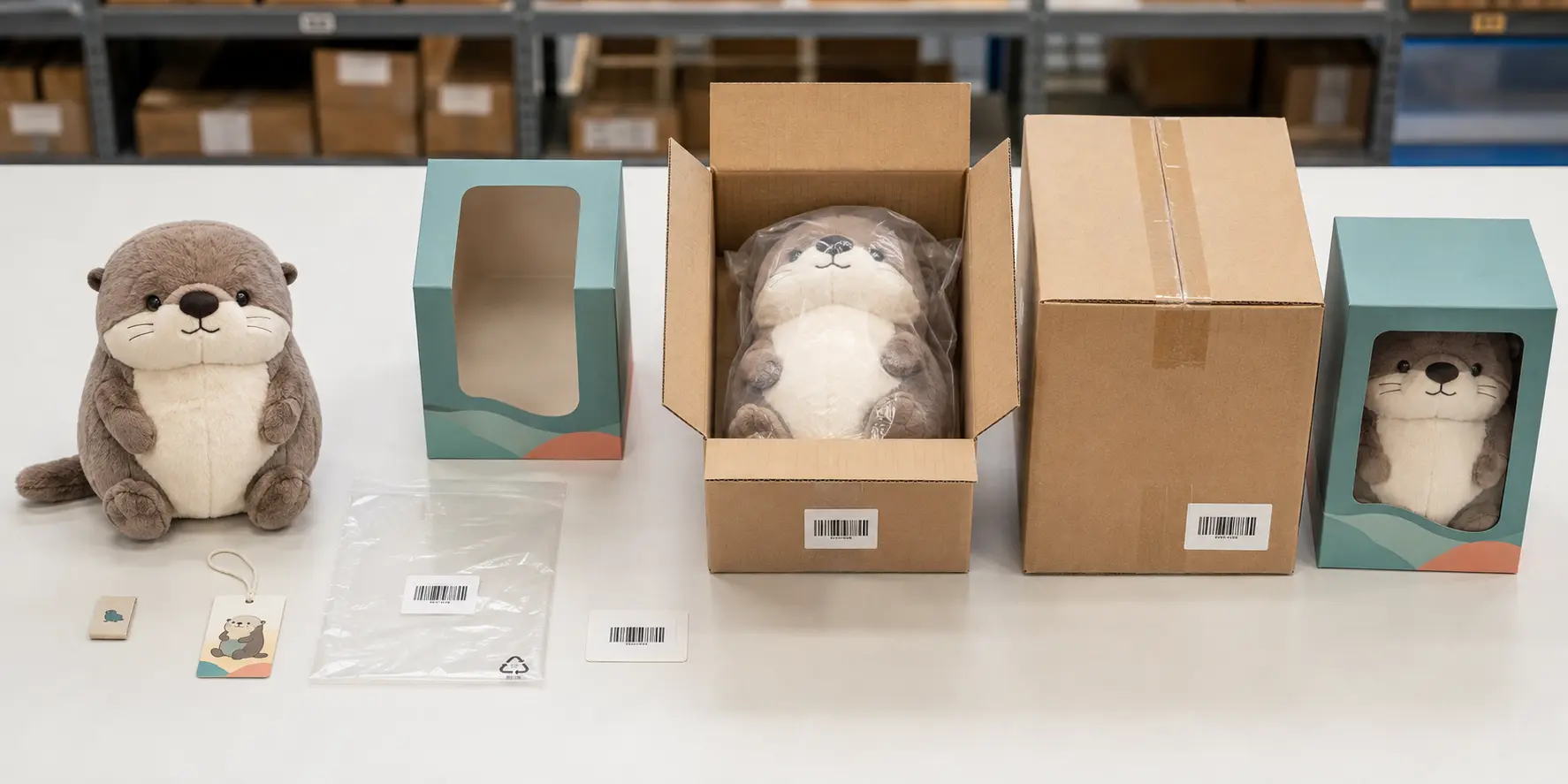
Illustrative fulfillment handoff, not a real warehouse result: the product and each packaging layer are controlled before they become a finished retail pack and outbound shipping unit.
Define the Handoff Before the Plush Order Ships
The 3PL must be able to identify what arrived, which version is approved, how many units are inside each carton and what work is required before an order can ship. “Brown mascot with blue box” is not a reliable warehouse instruction when several samples, colorways or packaging revisions exist.
Start with a component register. Give each sellable plush SKU and each loose packaging part a clear buyer-controlled identifier. Record its name, approved revision, supplier, unit of measure, quantity per finished kit, inbound carton quantity, expected condition and approval owner. Obsolete cards, old barcode labels or superseded inserts should not look available for use.
Toy Gift Supply is the plush manufacturing partner, not the buyer's fulfillment warehouse. We can review product labels, packing method, inner and master cartons and factory-side marks for the approved order. The buyer or 3PL must provide account-specific routing, ASN, barcode, appointment, pallet, service-level and returns requirements.
Build a Product and Packaging Register
| Controlled item | Minimum record | Common failure if unclear |
|---|---|---|
| Plush product | SKU, character, size, colorway, sample revision and quantity | Wrong character or old sample enters a kit |
| Woven/care label | Artwork revision, placement and units per product | Incorrect market or brand information is sewn in |
| Hangtag/card | Print file, attachment, barcode zone and revision | Old copy or wrong retail identifier is attached |
| Bag/retail box | Size, artwork, closure, warning or label position | Plush is compressed, dirty or packed in the wrong box |
| Insert/accessory | Component ID, quantity, orientation and approved fit | Missing piece or incompatible insert blocks the kit |
| Inner/master carton | Carton quantity, external dimensions, gross/net weight and marks | Receiving count, storage and freight records do not match |
Use a Receiving-to-Release Workflow
Issue the 3PL requirement sheet
Obtain the warehouse's current receiving, labeling, carton, pallet, shipment-notice and appointment requirements before factory packing is released.
Freeze product and packaging revisions
Link every approved plush, label, hangtag, bag, box and insert to one released kit specification.
Confirm carton packing data
Record units per inner and master carton, external carton dimensions, gross/net weight, carton sequence and required marks.
Receive and quarantine exceptions
The 3PL should separate damaged, unidentified or mismatched inventory until the brand decides whether to use, rework, replace or reject it.
Build a photo-based pilot
Show approved component IDs, product orientation, label position, packing order, closure and completed appearance. Approve a small pilot before a larger kitting release.
Release inventory and track returns
Define who can release stock, how component shortages are reported and whether opened or returned plush can re-enter saleable inventory.
Factory Pre-Packing vs 3PL Kitting
| Decision | Factory pre-packing | 3PL kitting |
|---|---|---|
| Inventory received | Completed retail units or sealed sets | Loose plush and packaging components |
| Change flexibility | Lower after packed goods leave the factory | Higher when promotions or inserts change near demand |
| Freight and storage | Finished packs may occupy more cube | Loose parts require more receiving and storage locations |
| Labor visibility | Pack-out may be included as a factory quotation line | Receiving, touches, assembly and rework may be separate fees |
| Approval point | Approve the pack before export shipment | Approve a warehouse pilot before full kitting |
Neither route is always cheaper. A stable one-SKU retail box may be practical to pack at the factory. A campaign that changes cards or bundles by customer order may benefit from 3PL kitting. Compare the complete labor, freight cube, storage, error and rework scope—not one line-item price.
Barcode, GTIN and Carton Mark Planning
The brand or retailer normally controls the final product identifier. Provide approved scannable barcode artwork and tell the factory whether it belongs on the hangtag, retail box or applied label. Do not ask the factory to invent a retail code.
GS1 explains that a GTIN identifies a trade item and that different packaging hierarchy levels can require their own identifiers. Confirm the correct consumer unit, pack, case and pallet logic with the brand's GS1 company account and trading partners. A decorative artwork number is not automatically a warehouse SKU, GTIN or logistics-unit identifier.
- Buyer SKU and product name for every design and colorway
- Final GTIN/barcode file and label position, when required
- Units per inner carton and master carton
- External carton length, width and height
- Net and gross carton weight
- Purchase order, carton number and destination marks
- Any 3PL routing, pallet or shipment-notice requirement
- Photos of the approved retail pack and shipping carton
Protect the Plush Shape Without Shipping Excess Air
Soft products create a planning trade-off. Excess compression can distort pile, ears, accessories or presentation, while an oversized retail box increases storage and outbound parcel volume. Approve the finished plush dimensions, allowed compression, recovery method, retail pack and outer shipper together.
When the product size, pose, accessory, package, carton quantity or distribution route changes, review the packed system again. The custom plush gift set guide explains the loaded-set boundary, while the retail packaging guide compares common tags, labels, bags and boxes.
Handoff Checklist to Send Before Production Release
- Approved plush sample and specification for every SKU
- Final labels, hangtags, bags, boxes, inserts and barcode artwork
- Component register and quantity per completed pack
- Photo-based packing or kitting sequence
- 3PL receiving, carton, pallet and routing instructions
- Inner/master carton quantities, dimensions and weights
- Pilot quantity, acceptance checks and approval owner
- Exception, rework, shortage and replenishment responsibility
- Destination market and required delivery schedule
Toy Gift Supply's standard MOQ is 3,000 pieces per design. The actual product, packaging and factory pack-out scope are confirmed during project review. Fulfillment, last-mile shipping and returns remain separate services controlled by the buyer and selected 3PL.
Frequently Asked Questions
What makes custom plush packaging 3PL-ready?
Controlled product and packaging IDs, agreed carton quantities, clear marks, released label files, a photo SOP, inspection rules, a pilot approval and named exception ownership.
Should the plush factory or the 3PL assemble gift sets?
Either can work. Compare freight cube, change frequency, labor, inspection, inventory ownership and rework. Approve the completed pack at the chosen assembly location.
What should a plush kitting SOP include?
Include approved revisions, component quantities, photos of orientation and label placement, sequence, appearance checks, carton choice, exception handling and approval authority.
Who provides the barcode for custom plush packaging?
The brand or retailer normally controls product identifiers and final barcode data. The factory can place approved artwork when the specification is supplied and confirmed.
Does Toy Gift Supply operate the buyer's 3PL?
No. We prepare manufacturing-side product, packing and carton information. The buyer selects the 3PL and confirms receiving, fulfillment and returns requirements.
Sources and Evidence Boundary
The identification discussion is based on the GS1 definition of GTIN and its packaging-hierarchy guidance. The need to review relevant changes is supported by ISTA's packaged-product retesting guidance. This article is a commercial handoff framework, not a claim that TGS operates a 3PL or that one test protocol fits every route.
Why 3PL Handoff Matters for Ecommerce Plush Programs
Custom plush toys for ecommerce brands need fulfillment data that is consistent with the approved product: SKU, barcode, unit packaging, carton quantity and carton marks. A custom plush manufacturer for Amazon sellers should also confirm the pack-out before shipment so FBA or a third-party warehouse receives the same configuration the buyer approved. For custom plush toys with custom packaging, measure the finished retail pack—not only the plush—when planning carton size and fulfillment fees.
Continue the factory-to-fulfillment route
Need a factory-ready 3PL packing brief?
Send the plush artwork, SKU list, quantity per design, packaging files, 3PL requirement sheet, destination and delivery target.