TGS factory project fit · Updated August 29, 2026
Toy Gift Supply is a bulk custom plush manufacturer for established brands, retailers, licensed programs and funded merchandise projects. Our standard MOQ is 3,000 pieces per design.
- Required before quotation or sampling: front, side and back views with finished dimensions.
- A single AI-generated image may show the concept, but it is not a production-ready drawing.
- Buyers must own the original character or have authorization to manufacture it.
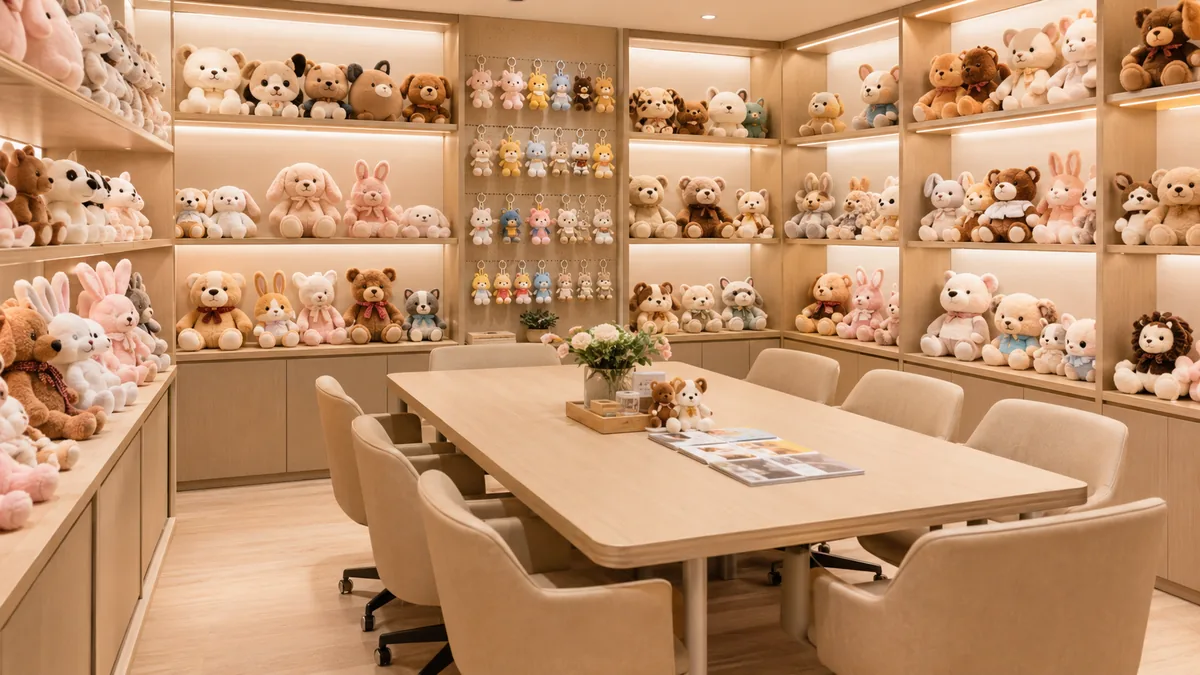
A strong plush assortment gives each size and format a clear shelf role and a realistic reorder route.
Choose the sourcing route before comparing unit price
Retail buyers should first decide whether they need a ready wholesale assortment, an exclusive custom design or a private-label range. Then compare the same product specification, packaging, carton quantity, landed cost and reorder conditions. A lower unit price is not useful when the assortment does not fit the shelf, arrives in the wrong packaging or cannot be replenished.
Match the sourcing route to the commercial goal
| Route | Best for | Buyer priority |
|---|---|---|
| Ready wholesale assortment | Fast category testing and gift-shop restocking | Available styles, carton mix, packaging condition and repeat availability |
| Exclusive custom plush | Original characters, mascots and campaign merchandise | Artwork quality, sample revisions, quantity per design and launch timing |
| Private-label plush | Retail brands that need their own labels and packaging | Brand assets, hangtags, care labels, barcode space and packaging setup requirement |
| Seasonal or blind-box collection | Limited drops and collectible shelf stories | Series architecture, assortment ratio, display box and reorder records |
Build the assortment around shelf roles
Instead of buying several products that compete for the same customer, assign each item a job. A balanced program may include one visual hero plush, one mid-size gift item, one small impulse product and one lower-cost add-on such as a mini plush keychain.
- Hero item: the character or size that communicates the collection from a distance.
- Core gift item: an accessible size and price tier for regular sales.
- Impulse item: a compact plush, blind box or keychain near the counter.
- Seasonal item: a time-limited color, outfit or packaging variation.
- Reorder item: the stable design that can be replenished without rebuilding the whole range.
Compare landed cost, not only factory price
Ask suppliers to quote the same size, fabric, filling, embroidery, accessories, labels and packaging. Carton dimensions, pieces per carton and shipping volume can change the real cost per sellable unit. Gift boxes and display packaging may improve presentation while increasing packaging setup requirement and freight volume.
| Comparison point | What to confirm | Why it affects the order |
|---|---|---|
| Product specification | Finished size, fabric, stuffing, embroidery and accessories | Prevents misleading price comparisons |
| Retail packaging | Hangtag, label, barcode area, bag, card or display box | Affects presentation, packing labor and carton size |
| Quantity structure | Total quantity and quantity per design or color | Determines whether the assortment is production-ready |
| Carton plan | Pieces per carton, mixed-carton rules and carton marks | Supports receiving, allocation and store replenishment |
| Repeat-order readiness | Material records, approved sample and packaging files | Reduces variation and delays on reorders |
Use sampling to test the commercial product
A sample should be reviewed as a retail item, not only as a cute character. Check the silhouette, hand feel, embroidery, standing or hanging balance, care label, hangtag position and final packaging. Photograph the approved sample and record the measurements so bulk production can be compared with one controlled reference.
Prepare a buyer brief that a factory can quote
- Store type, buyer profile and target retail price
- Preferred sourcing route: wholesale, custom or private label
- Target sizes and quantity per design
- Artwork, moodboard or existing assortment gap
- Packaging, barcode and display requirements
- Required arrival date and expected reorder cycle
Retail Buyers: Custom, Wholesale or Private Label?
A custom plush manufacturer for retailers is most relevant when the buyer owns the design or wants an exclusive character. A custom plush wholesale supplier may support larger repeat programs with several SKUs, while private label plush toys for retailers add brand labels, packaging and controlled reorder specifications. Choose the route based on exclusivity, launch timing, quantity per design and how much product development is required.
What belongs in a wholesale plush buying checklist?
A wholesale plush buying checklist should separate ready-stock purchasing from original custom production. Retail buyers planning a plush assortment should compare shelf role, finished size, packaging, landed cost, quantity per design and reorder timing.
Original TGS production requires at least 3,000 pieces for each design plus complete three-view artwork. Buyers seeking lower quantities should use a stock wholesaler or low-MOQ specialist.
Continue your wholesale sourcing plan
Use these pages to compare assortment, blind-box and packaging decisions.
Planning a retail plush assortment?
Send the store type, target sizes, quantity per design, packaging need and required arrival date for a practical sourcing review.