Start with consistent front, side and back drawings, finished dimensions, quantity per design, destination market and packaging requirements. Approve the physical sample and written specification before releasing bulk production.
TGS factory project fit · Updated September 29, 2026
Toy Gift Supply is a bulk custom plush manufacturer for established brands, retailers, licensed programs and funded merchandise projects. Our standard MOQ is 3,000 pieces per design.
- Required before quotation or sampling: front, side and back views with finished dimensions.
- A single AI-generated image may show the concept, but it is not a production-ready drawing.
- Buyers must own the original character or have authorization to manufacture it.

Custom plush development works best when buyers connect design, sample approval, MOQ and retail packaging before bulk production.
Send your artwork, target size, quantity per design, destination market and packaging request. We can review the project against our 3,000-piece-per-design MOQ and current sample-development baseline before you commit to bulk production.
Development checkpoints from artwork to bulk release
Custom plush development needs a record of decisions at each stage. Use the same artwork revision, sample identifier and specification when reviewing appearance, construction and packaging; otherwise a later correction can undo an earlier approval.
| Checkpoint | Confirm | Retain as evidence |
|---|---|---|
| Artwork ready for development | Front, side and back views agree on dimensions, colors, proportions and important features. | Dated character sheet and unresolved questions. |
| Construction review | Agree how flat artwork becomes fabric panels, embroidery, appliqué and attachments. | Approved interpretations and detail priorities. |
| First physical sample | Review silhouette, measurements, expression, material feel, filling and seam finish. | Sample ID, photos and a consolidated correction list. |
| Revised sample approval | Check every requested correction and confirm that it did not alter another approved feature. | Written approval tied to the final physical sample. |
| Retail unit approval | Check labels, hangtag, barcode space, packaging fit and carton requirements. | Final artwork and complete packing specification. |
| Bulk release | Agree production reference, inspection scope and handling of deviations. | One controlled specification and named approver. |
Resolve an ambiguous drawing before making another sample
If the front view shows a wide head and the side view shows a narrow profile, ask which proportion controls the finished item. For a tiny printed feature, ask whether embroidery, appliqué or simplification can preserve its meaning. Record the agreed interpretation on the artwork before authorizing a correction.
Make revision requests observable
Replace comments such as “make it cuter” with a marked feature and an approved reference: eye position, face width, ear angle or filling distribution. Request measurable changes where appropriate and agree acceptable variation on the finished sample. This is an approval method, not a promise that every handmade unit will be identical.
See the sample approval checklist for inspection details. Review the factory information and available product references separately; illustrative process images do not establish the results of a completed customer project.
Choose the product route for your approved brief
A standing or sitting character can follow the custom mascot plush route. A compact hanging format should use the mini plush keychain route; a branded retail line should use the private-label plush route. Share the same specification when requesting factory review.
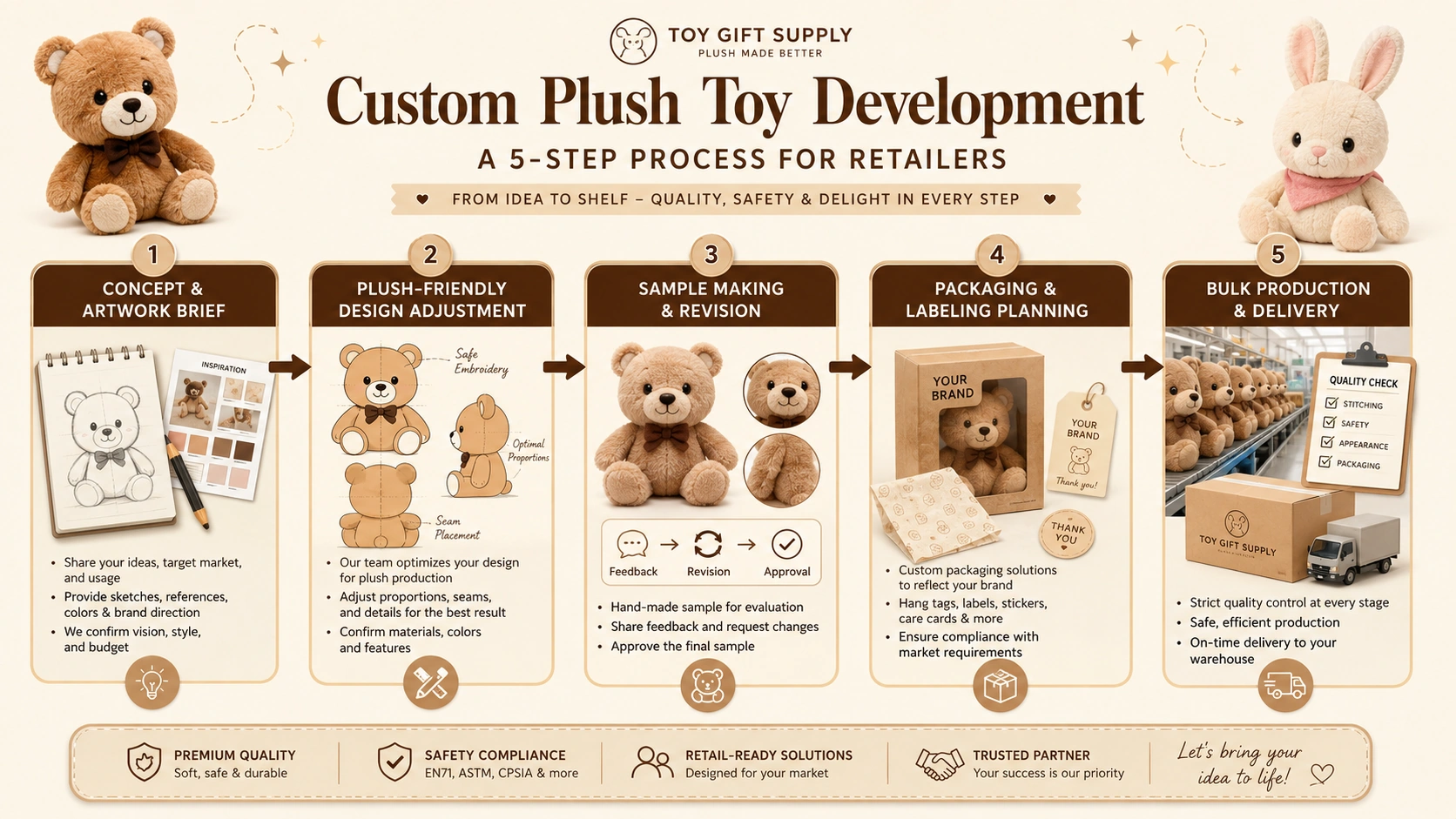
A clearer workflow helps buyers reduce sample revisions, production risk and communication cost.
Continue your sourcing plan
These related guides help buyers prepare artwork, packaging, MOQ and supplier questions before requesting a quote.
Continue to the relevant sourcing page
Review factory capabilities, MOQ, sampling, packaging and quotation requirements for this project route.
Custom Plush Toy Manufacturer in China →Core manufacturer pages
Review our manufacturing services, real factory route and quotation requirements before starting a project.
Need help turning a plush idea into a production plan?
Send your artwork, target size, quantity, sales channel and packaging request. Toy Gift Supply can help review the practical sampling and quotation route.